

Most CROs and CFOs now expect one thing from Salesforce forecasting — and many teams still struggle to show it clearly:
Salesforce forecast accuracy — measured continuously against actual closed revenue.
Not just whether the number was hit at quarter end, but:
how far off the forecast vs actual result was
whether the sales team tends to over-forecast or sandbag
whether forecast accuracy is improving or declining over time
Teams that have this in place don’t talk about “forecast confidence” anymore.
They show it — using a Salesforce forecast accuracy dashboard built from CRM data.
This article is written for CROs, CFOs, and revenue leaders responsible for forecasting accuracy and board-level confidence — not for CRM administrators.
Salesforce forecast accuracy dashboard (example)
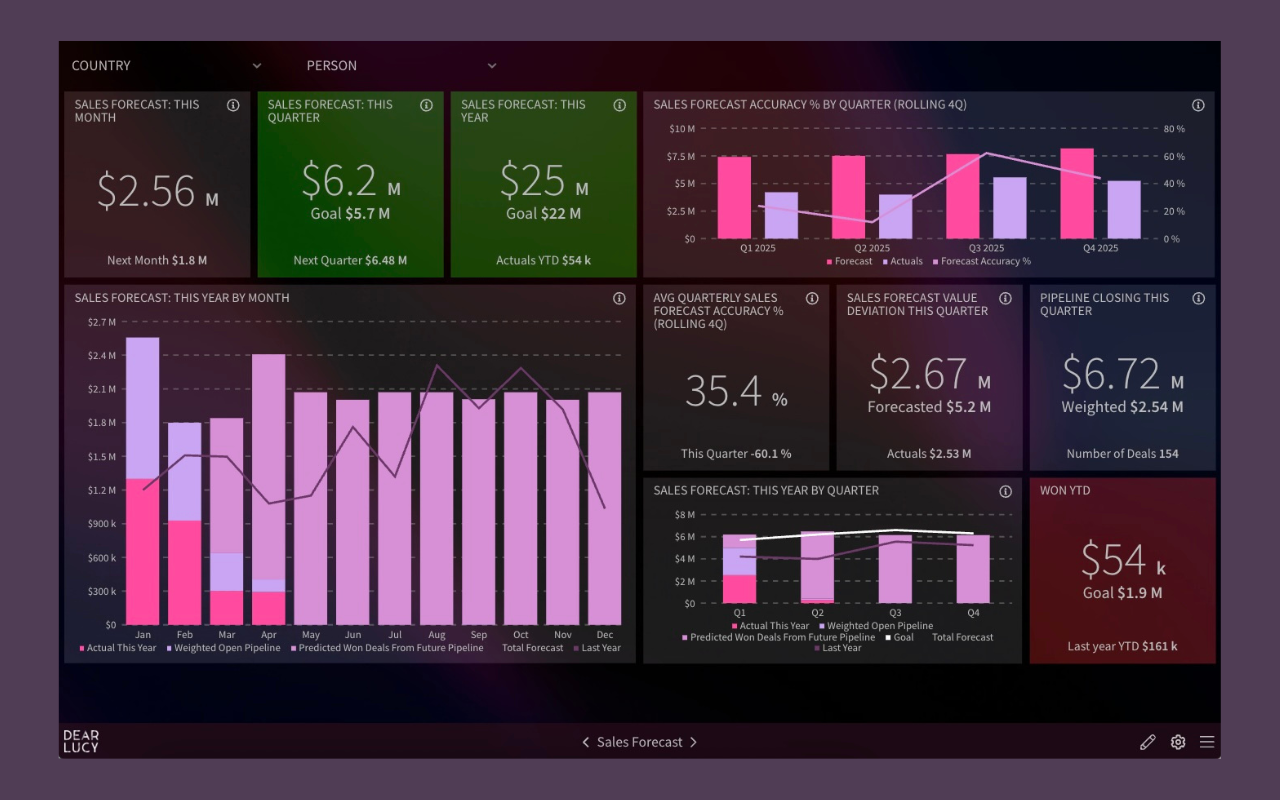
Salesforce forecast accuracy dashboard showing forecast vs actual revenue, deviation, bias, and accuracy trends — used by CROs and CFOs to assess forecast reliability week by week.
This single view has become a baseline expectation in board meetings and CFO reviews.
If leadership can’t answer “How accurate is the Salesforce forecast right now?”, trust erodes quickly — even when pipeline volume looks strong.
TL;DR: Salesforce forecast accuracy (for executives)
Salesforce forecast accuracy measures how close your forecasted revenue is to actual closed revenue.
Modern revenue teams track forecast accuracy continuously to:
calibrate confidence in the forecast
identify risk earlier in the quarter
improve forecasting behavior over time
This allows CROs and CFOs to run forecast calls and board updates based on measured reliability, not gut feel.
What a Salesforce forecast accuracy dashboard makes visible
A well-designed forecast accuracy dashboard in Salesforce answers questions leadership already asks:
How accurate was our Salesforce forecast last quarter?
Are we consistently over-forecasting or under-forecasting?
Is forecast accuracy improving as the quarter progresses?
Which teams, regions, or segments behave differently?
How much confidence should we place in today’s forecast?
Without this visibility, all forecast numbers are treated as equally trustworthy — which is exactly why boards stop trusting them.
Why Salesforce forecast accuracy is now a board-level expectation
In many B2B companies, sales forecasting is no longer a Sales Ops exercise.
Boards and CFOs rely on Salesforce-based forecasts to make decisions about:
hiring and headcount timing
investment and spend pacing
cash flow planning
market or regional expansion
They don’t expect perfect forecasts.
They do expect predictability and transparency.
When Salesforce forecasts miss without context, leadership can’t tell:
whether the miss was reasonable or avoidable
whether risk was visible early enough
whether forecasting behavior is improving or repeating the same bias
Forecast accuracy provides that context.
It turns Salesforce forecasting from an opinion into a measurable signal.
Forecast accuracy is not a modeling problem — it’s a behavioral one.
Poor forecast accuracy is rarely caused by formulas.
It’s caused by CRM behavior.
Common Salesforce issues that damage forecast accuracy:
opportunities with outdated close dates
deals stuck in late stages without activity
inconsistent use of Commit vs Best Case
missing or unreliable CRM data
High-performing teams don’t treat CRM hygiene as a cleanup project.
They surface it continuously using CRM hygiene dashboards tied directly to forecasting.
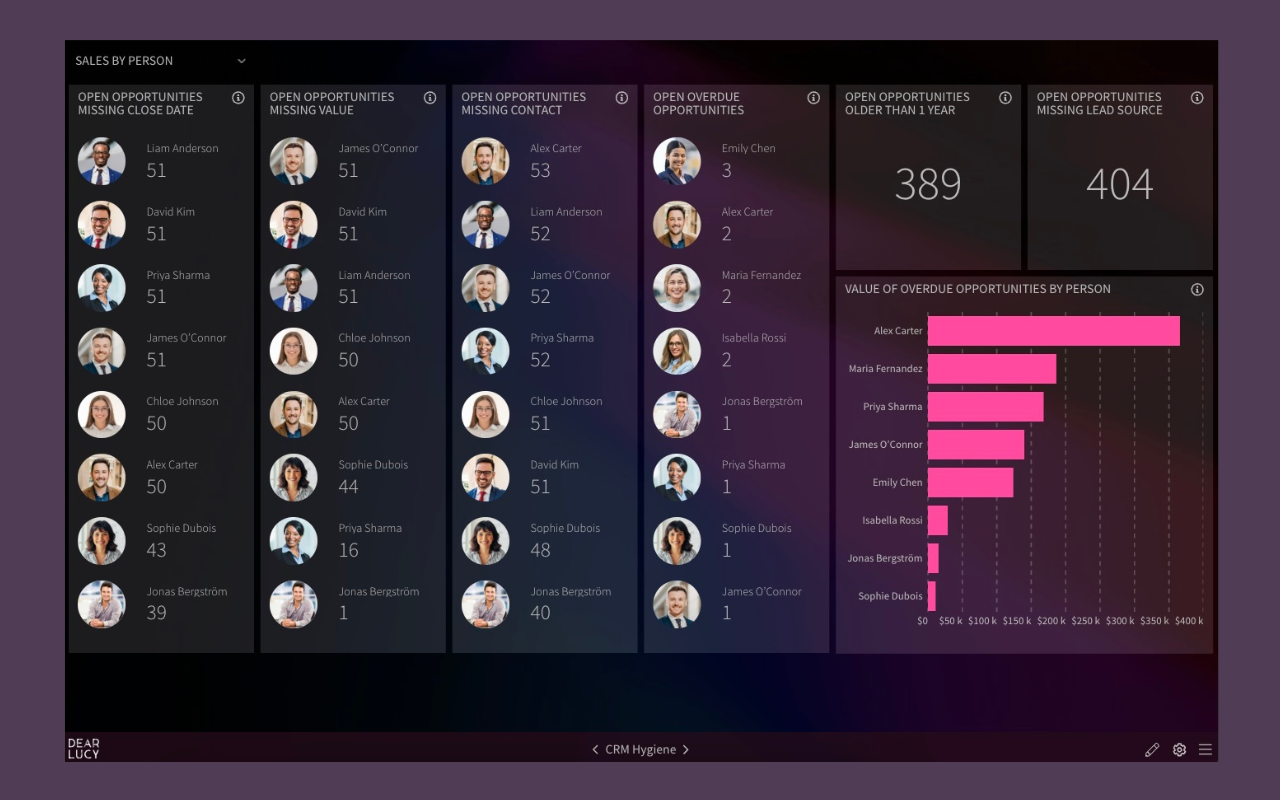
CRM hygiene dashboard highlighting stalled deals, missing data, and inactive opportunities — surfaced early to protect forecast accuracy.
This improves forecast accuracy because it improves sales behavior.
How accurate Salesforce forecasting teams operate week to week
Accurate Salesforce forecasting is created through operating rhythm, not reporting.
Strong revenue teams follow a consistent process:
weekly Salesforce forecast calls
forecast vs actual variance tracking
explicit ownership of Commit quality
visibility into forecast bias and slippage
This shifts forecast calls from defending numbers to making decisions.
Key insight for CROs: Forecast accuracy improves when teams know it is measured — and reviewed regularly.
This is the same operating rhythm modern teams use to run forecast calls, track pacing, and surface risk early.
What is a good Salesforce forecast accuracy benchmark?
Sales leaders don’t need complex models.
They need reference points.
Common Salesforce forecast accuracy benchmarks:
±5% by the final month of the quarter → best-in-class
85–90% accuracy → strong for most B2B companies
Commit accuracy higher than Best Case → expected
Renewals more accurate than new business → normal
These benchmarks assume a disciplined forecasting process; without CRM hygiene and bias tracking, accuracy percentages are misleading.
The goal is not perfection.
The goal is knowing how reliable the Salesforce forecast is today.
One Salesforce revenue view, many stakeholders
Executives don’t need CRM access.
They need trusted Salesforce-based dashboards.
In practice, this usually means a small set of leadership dashboards that are used consistently across forecast calls, reviews, and board meetings.
When forecast accuracy, pacing, and outcomes roll up from the same Salesforce data:
leadership alignment improves
board discussions move faster
forecast credibility increases naturally
This is how Salesforce forecasting becomes a leadership system — not just a report.
Why Salesforce alone often isn’t enough for forecast accuracy
Salesforce stores the data.
Forecast accuracy requires context, trends, and accountability.
Native Salesforce reports answer:
“What does the pipeline look like?”
Leadership needs to answer:
“How accurate has this forecast been — historically and right now?”
That gap is why many teams still export Salesforce data into spreadsheets or decks.
How to track Salesforce forecast accuracy in practice
With Dear Lucy, revenue teams track Salesforce forecast accuracy automatically, without manual work.
The Forecast Accuracy Dashboard shows:
forecast vs actual deviation (€ / $)
monthly and quarterly forecast accuracy %
accuracy trends over time
bias (over-forecasting vs sandbagging)
breakdowns by team, region, or business unit
This gives CROs and CFOs a live view of forecast reliability — directly on Salesforce data.
If you’re looking for a deeper comparison of Salesforce’s native forecasting versus predictive approaches, we cover that separately.
Connect Salesforce. Dashboards appear automatically.
FAQ: Salesforce forecast accuracy
What is Salesforce forecast accuracy?
Salesforce forecast accuracy measures how close forecasted revenue is to actual closed revenue over time.
How is Salesforce forecast accuracy calculated?
Most teams use percentage deviation between forecast and actual revenue, often tracked monthly or quarterly.
What is a good Salesforce forecast accuracy percentage?
Best-in-class teams aim for ±5% by the end of the quarter. Most B2B teams operate around 85–90%.
Why do Salesforce forecasts lose credibility?
Common reasons include deal slippage, inconsistent Commit usage, poor CRM hygiene, and optimism bias.
Who owns forecast accuracy in Salesforce?
CROs own forecast credibility. RevOps supports reporting. Managers own forecast behavior within teams.
TL;DR: Salesforce forecast accuracy
Definition: How close Salesforce forecasts are to actual revenue
Why it matters: Enables trust, predictability, and better decisions
How it’s measured: Forecast vs actual deviation over time
What breaks it: CRM hygiene issues and bias
How to improve it: Continuous tracking, clear ownership, and automation