

If you’re running revenue in Salesforce, forecasting usually isn’t failing because of missing data. It fails when leaders stop trusting what the forecast is actually telling them.
Most CROs recognize the pattern.
Forecast calls feel heavier than they should.
Numbers get updated late.
Optimism creeps in early.
Pressure shows up late.
And somewhere along the way, the conversation drifts from decisions to explanations.
This post breaks down how modern revenue teams actually forecast in Salesforce — not as a one-off report, but as an operating rhythm. From forecast calls, to pacing, to accuracy tracking, it’s about building trust week by week, not just hitting a number at quarter end.
TL;DR
Modern Salesforce forecasting isn’t about choosing the “right” model — it’s about building trust through consistent forecast calls, clear pacing, early risk signals, and accuracy tracking. Strong sales leaders rely on a small set of forecasting views to guide weekly decisions, intervene early, and keep leadership aligned around one revenue truth.
What this post is — and what it isn’t
Before going further, one clarification.
This post is not about:
How to configure Salesforce forecasting
Technical setup or admin-level decisions
We already cover forecasting methods elsewhere.
This post is about how CROs and sales leaders use forecasting in practice:
In weekly forecast calls
In leadership reviews
In board conversations
It’s about how forecasting supports leadership decisions, not how it’s built.
The forecast call is the operating system
For most sales leaders, forecasting lives or dies in one place: the forecast call.
That’s where leadership needs a clear answer to one simple question:
Are we on track — and what needs attention right now?
Strong teams anchor this conversation around a single forecast view that brings together:
Forecast vs target
Commit and best case
Pipeline coverage
Deals at risk
Not to achieve perfect precision — but to create a shared understanding.
When this view works, forecast calls stop being reconciliation sessions.
The numbers are already trusted, so the discussion shifts to risk, trade-offs, and action.
Leaders spend less time asking “Are these numbers right?”
And more time deciding “What do we do next?”
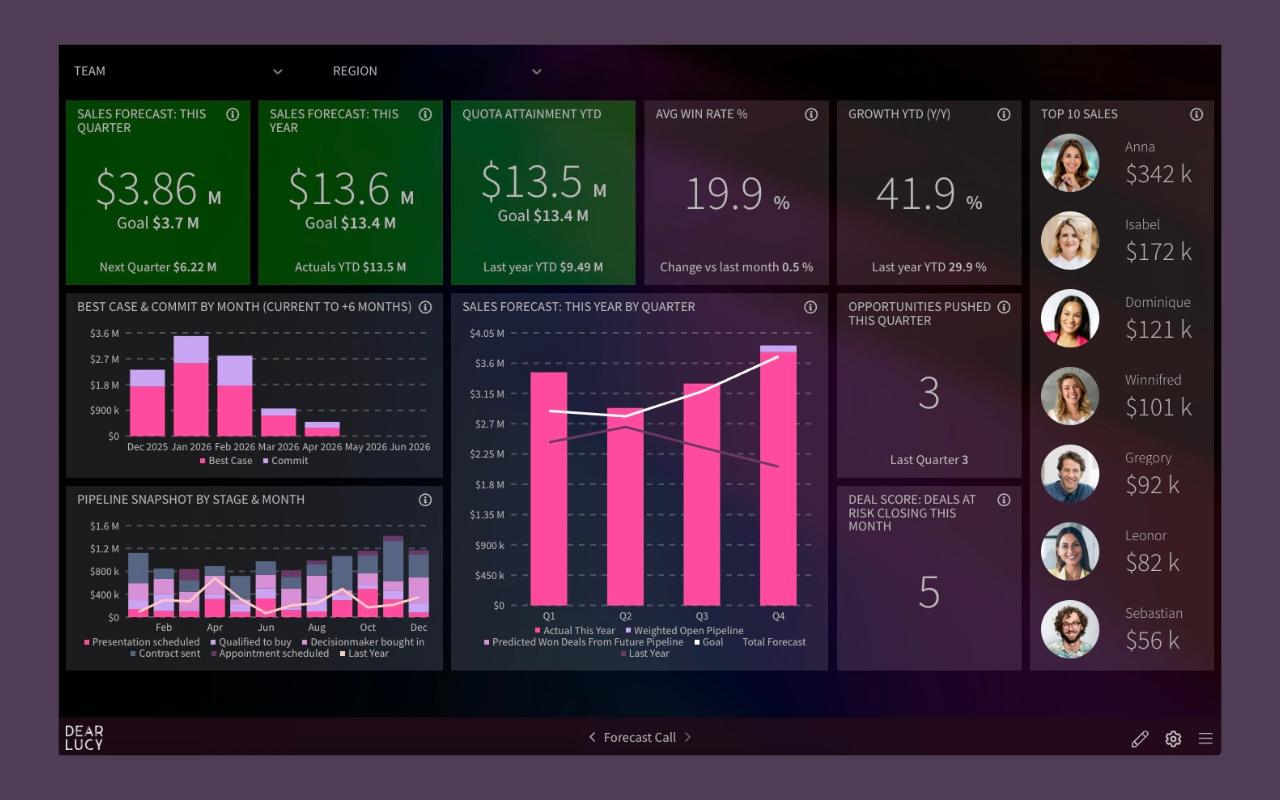
A Salesforce forecast call dashboard combining forecast vs target, pipeline coverage, deal risk, and goal pacing — in one view.
Run your next forecast call with confidence
Connect Salesforce. Dashboards appear automatically.
Why experienced teams don’t trust raw pipeline
Most teams start forecasting by rolling up pipeline and applying probabilities.
That works — until it doesn’t.
Over time, CROs learn a hard truth:
raw pipeline reflects optimism more than reality.
Close dates slip.
Deals stall.
Probability fields get nudged to “look better.”
None of this is malicious. It’s human behavior.
That’s why experienced teams don’t rely on raw pipeline alone.
They layer in adjustments that reflect how their business actually behaves:
Slippage-adjusted forecasts that account for historical close-date movement
Deal score–based forecasts that surface which deals are truly hot — and which are quietly at risk
The goal isn’t to replace judgment with models.
It’s to give leaders better signals earlier, before problems show up too late.
Good forecasts don’t remove uncertainty.
They make risk visible sooner.
Strong forecast calls rely on more than pipeline totals — they depend on knowing how reliable the forecast actually is. That’s why modern teams continuously track Salesforce forecast accuracy week by week.
For organizations selling subscriptions, services, or multi-year contracts, forecasting often extends beyond pipeline value into revenue timing, Revenue Schedules, and target attainment. Read our guide on how to automate revenue forecasts from Salesforce data.
Pacing is how leaders stay proactive
Quota tells you where you need to end up.
Pacing tells you whether you’re going to get there.
This is where many forecasts quietly fail.
Teams look at totals, but not trajectory.
They notice gaps when the quarter is almost over — when the only lever left is pressure.
Strong forecasting includes goal pacing at every level:
Individual reps
Teams
Regions
The full company
Pacing makes it obvious whether performance is:
Ahead
On track
Slipping
— with enough time to act.
Leaders can intervene earlier, shift focus, and coach with intent instead of urgency.
Traffic-light pacing doesn’t just show progress.
It changes behavior.
Forecast accuracy is how trust is built
The most mature forecasting teams don’t only look forward.
They look backward.
Forecast accuracy tracking is one of the most underused — and most powerful — tools for building trust in revenue numbers.
Instead of asking only “Did we hit the number?”, strong teams ask:
How accurate were our forecasts last month or quarter?
Were we consistently optimistic or conservative?
Is accuracy improving over time?
This creates a feedback loop.
Leaders learn how reliable their forecasts really are.
Teams learn how their behavior affects outcomes.
Over time, confidence grows — not because forecasts are perfect, but because they’re consistently honest.
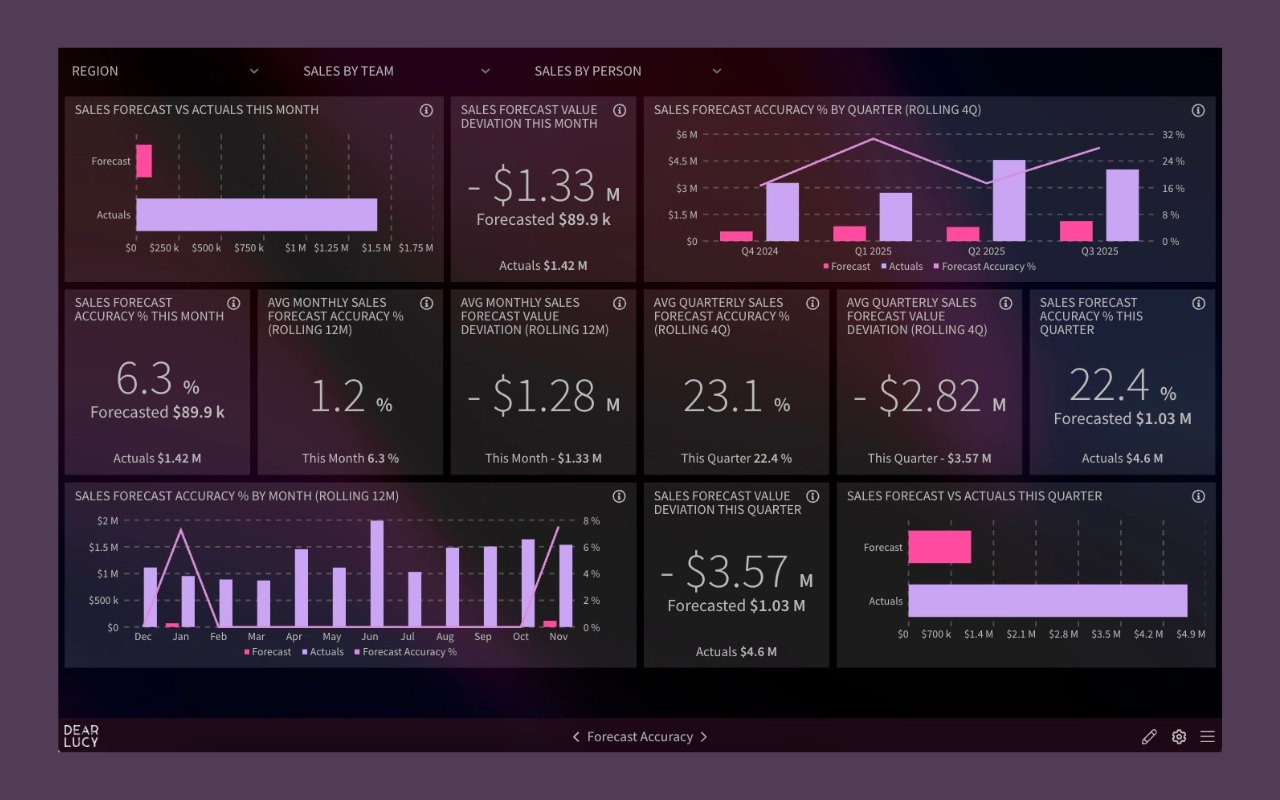
Forecast accuracy tracking in Salesforce, showing forecast vs actuals, deviation, and accuracy trends over time to help sales leaders build trust in their forecasts.
One forecast, many lenses — same truth
Modern forecasting isn’t about choosing one model over another.
Strong teams layer:
A clear forecast-call view
Slippage-adjusted expectations
Deal risk signals
Goal pacing
Accuracy tracking over time
All of it feeds the same revenue conversation.
Executives, managers, and reps may look at different views —
but they’re all grounded in the same data and logic.
That alignment is what turns forecasting from a reporting exercise into a leadership tool.
What “good” forecasting actually looks like
When Salesforce forecasting works for sales leaders, the change is subtle — and powerful.
Forecast calls become calmer.
Teams focus on risk instead of excuses.
Leaders intervene earlier.
Board updates come from numbers leadership already trusts.
That’s not better forecasting because of smarter math.
It’s better forecasting because the system supports how leaders actually run the business.
Want to see how this works in practice?
Explore how revenue teams run forecast calls, track pacing, and measure forecast accuracy directly on Salesforce data — without spreadsheets or manual rollups.
Explore Salesforce forecasting with Dear Lucy
FAQ (for CROs, RevOps, and Salesforce leaders)
Is this about Salesforce native forecasting or alternative models?
This post focuses on how forecasting is used operationally. For a comparison of forecasting methods, see our dedicated forecasting methods guide.
Do modern teams still use forecast calls?
Yes — but the best teams use fewer numbers, more consistently, and focus the conversation on risk and action.
Why is forecast accuracy important?
Accuracy tracking builds trust over time. It shows whether forecasts are consistently optimistic or conservative and helps leaders calibrate decisions.
Is pacing the same as quota tracking?
No. Quota shows the target. Pacing shows trajectory — whether performance is moving fast enough to hit the target in time.
Can this be done directly on Salesforce data?
Yes. Modern forecasting layers logic and visuals on top of Salesforce data without requiring spreadsheets or manual rollups.