

Sales Forecasting
Sales forecasting breaks down when forecast calls turn into storytelling, spreadsheet debates, or last-minute number changes.
The root cause often starts earlier. Weekly pipeline reviews are where forecast accuracy is actually won or lost — yet most teams lack a clear, shared view of pipeline health and deal movement.
Dear Lucy gives sales teams forecasting dashboards built for pipeline reviews and forecast calls, helping teams align faster, spot risk earlier, and make decisions with confidence.
Unlike standard CRM forecasting, Dear Lucy can also estimate the future pipeline you're likely to create, giving leadership a more complete sales forecast.
Example sales forecasting dashboard
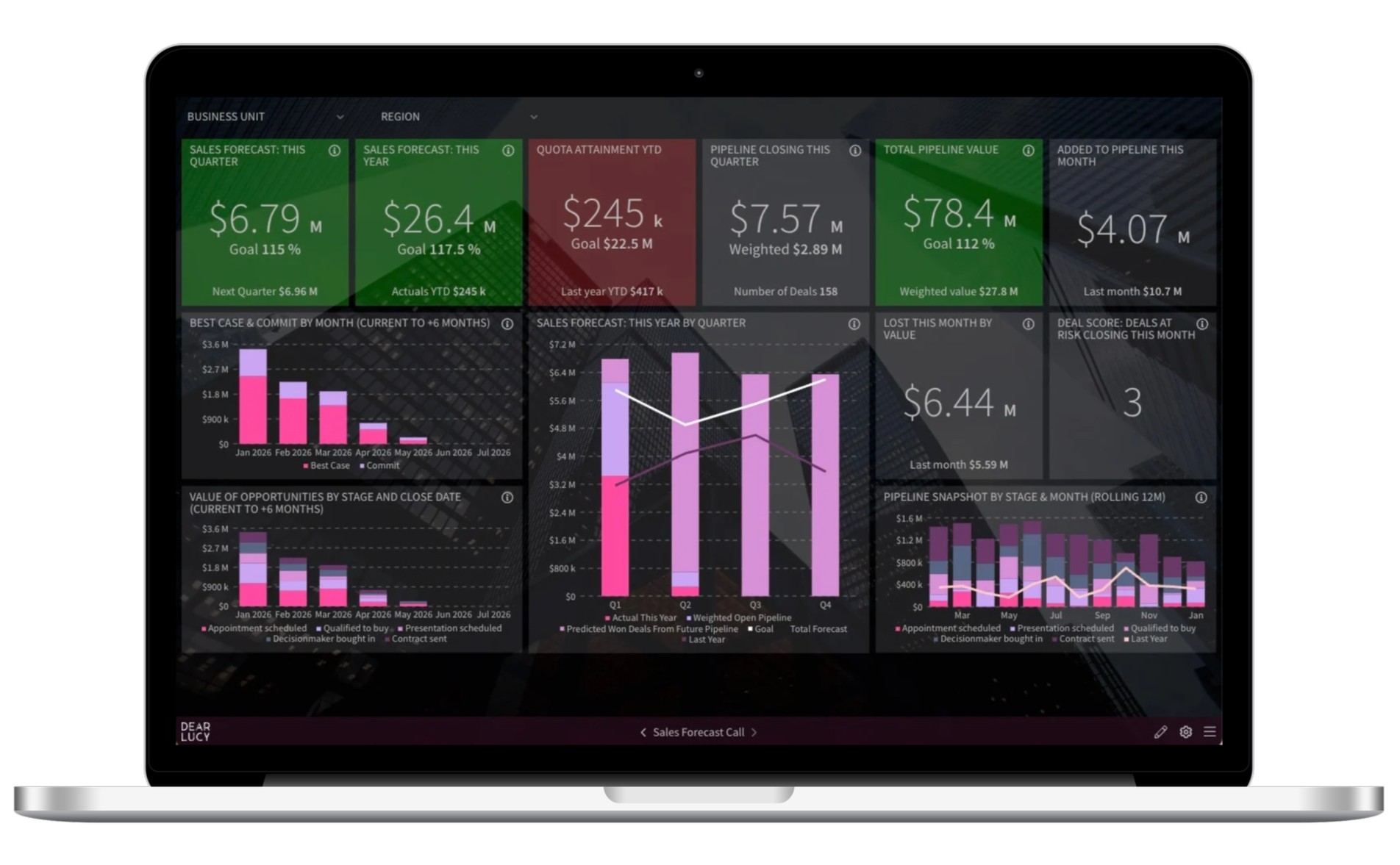
Sales forecasting dashboard used in forecast calls and pipeline reviews, combining forecast vs quota, best-case forecast, pipeline value, deal movement and pipeline snapshots to help sales teams review quarterly forecasts using live CRM data.
Why sales teams choose Dear Lucy for forecast calls
Plug-and-play forecasting dashboards
Sales forecasting dashboards are ready out of the box — built for forecast calls and weekly pipeline reviews.
No spreadsheets.
No manual rollups.
No rebuilding reports before every call.
Data-backed forecasts — not gut feel
Forecasts are grounded in real CRM data and deal behavior, not subjective confidence.
Teams see forecast vs target, pipeline coverage, deal movement, and forecast accuracy clearly — keeping discussions factual and aligned.
Visual goal pacing for fast alignment
Forecast progress is shown visually, making it instantly clear whether teams are on track or falling behind.
This keeps pipeline reviews and forecast calls focused on decisions and actions — not explanations.
How modern sales forecast calls & pipeline reviews actually work
With sales forecasting dashboards, forecast calls and pipeline reviews typically follow this flow:
Start with forecast vs target
Review pipeline coverage and health
Focus on deal movement since the last review
Surface risk and upside early
End with clear actions and owners
This structure keeps pipeline reviews short, consistent, and outcome-driven — and forecast calls grounded in reality.
What to review in a sales forecast call & pipeline review
Effective forecast calls and pipeline reviews focus on a small set of signals that actually move the number.
Forecast vs target
A clear view of where the team is likely to land — not just what’s already closed.
Pipeline coverage
Whether there is enough pipeline to realistically hit the number — now and in the next period.
Deal movement
What moved since the last review — pushed deals, pulled deals, and new additions.
Risk and upside
Which deals could break the forecast, and where growth may accelerate.
Trend over time
How forecast accuracy and pipeline health are evolving — not just a single snapshot.
This is what turns weekly pipeline reviews into reliable forecasting.
Look Beyond Today's Pipeline
Most CRM forecasting tools only forecast the opportunities that already exist.
Dear Lucy goes one step further.
Using your historical pipeline creation rate, win rate and average sales cycle, Dear Lucy estimates the revenue likely to come from opportunities that have not yet entered your CRM.
This gives sales leaders a more realistic forecast by combining today's pipeline with the business they are likely to create before the forecast period ends.
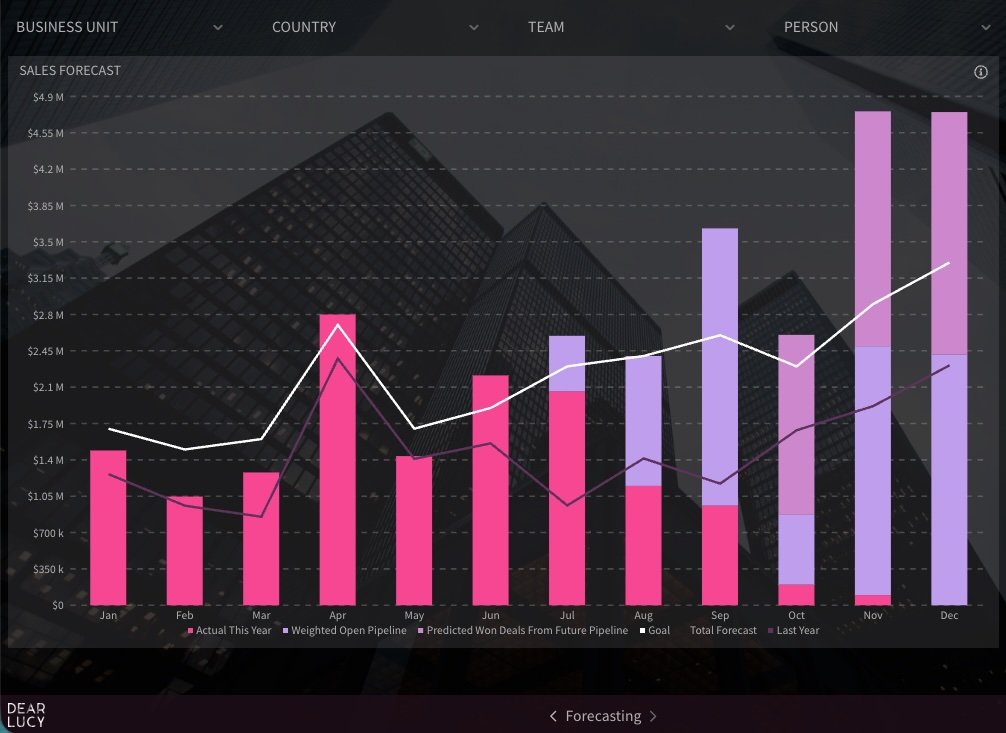
Sales forecast chart combining actual sales, weighted pipeline and predicted future pipeline, helping sales teams forecast revenue beyond today's open pipeline using live CRM data.
Improve Forecast Accuracy Over Time
Great forecasts don't just predict revenue—they become more accurate over time.
Most CRM systems focus on today's forecast.
Dear Lucy compares forecasted and actual sales over time, helping sales leaders identify forecasting trends, improve forecast accuracy and build greater confidence in future forecasts.
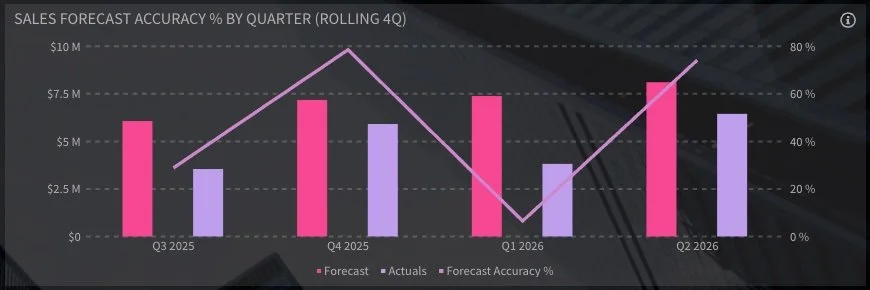
Sales forecast accuracy chart comparing forecasted and actual sales while tracking forecast accuracy over time, helping sales leaders improve forecasting confidence and identify forecasting trends.
One forecasting foundation — used across the business
Sales forecasting dashboards don’t live in isolation.
The same data and definitions are used for:
Weekly pipeline review meetings
Leadership forecast calls
This creates one shared version of the truth — from sales reps to leadership to the board.
Built on live CRM data
Dear Lucy connects directly to your CRM, so forecasts are always based on the latest data — not snapshots or exported spreadsheets.
Works seamlessly with:
Forecast calls and pipeline reviews are only as good as the data behind them — and that data is always current.
From pipeline reviews to confident reporting
Pipeline reviews shape everything that follows.
The same forecasting dashboards support:
Weekly and monthly leadership reviews
Board and investor reporting
Sales rep coaching and 1:1s
When pipeline reviews are consistent, forecasts stabilize — and trust in the numbers increases.
When sales forecasting dashboards matter most
This use case resonates strongly when:
Forecast calls feel unreliable or subjective
Pipeline reviews turn into long status meetings
Numbers change late in the quarter
Leadership wants higher forecast accuracy
Boards expect clearer explanations
If that sounds familiar, forecasting dashboards built for pipeline reviews and forecast calls are the missing foundation.
Frequently Asked Questions
What is sales forecasting?
Sales forecasting estimates how much revenue a sales team is likely to generate during a future period based on pipeline, historical performance and current sales activity. Effective sales forecasting helps organizations plan resources, improve forecast accuracy and make better commercial decisions.
Sales forecasting predicts which deals are likely to close, while Revenue Forecasting focuses on when those deals are expected to generate revenue. Learn more about Revenue Forecasting.
What's the difference between pipeline reviews and forecast calls?
Pipeline reviews focus on the quality, movement and health of opportunities in the pipeline. Forecast calls focus on expected revenue and whether sales targets are likely to be achieved. Most high-performing sales organizations combine both into the same reporting cadence.
What should a sales forecasting dashboard include?
A sales forecasting dashboard should provide a complete view of sales performance, including:
Forecast vs target
Pipeline coverage
Commit and best-case forecast
Deal movement
Risk and upside
Historical forecast accuracy
This gives sales leaders the context they need to make confident forecasting decisions.
How is Dear Lucy different from CRM forecasting?
Dear Lucy builds on your CRM rather than replacing it. In addition to standard CRM forecasting, Dear Lucy provides purpose-built dashboards for forecast calls, pipeline reviews, forecast accuracy tracking and predictive future pipeline, helping sales teams make more consistent and data-driven forecasting decisions.
Can Dear Lucy predict future pipeline?
Yes. Unlike standard CRM forecasting, Dear Lucy can estimate future pipeline that has not yet entered your CRM using historical pipeline creation, win rates and average sales cycle. This provides a more complete sales forecast than relying only on today's open pipeline.
Does Dear Lucy replace Salesforce or HubSpot forecasting?
Dear Lucy builds on your CRM rather than replacing it. It combines live CRM data into forecasting dashboards designed for forecast calls, pipeline reviews, executive reporting and sales management, giving teams a shared view of sales performance.
Which CRMs does Dear Lucy support?
Dear Lucy connects directly to Salesforce, HubSpot, Microsoft Dynamics 365 and Pipedrive, keeping sales forecasting dashboards automatically up to date with live CRM data.
Can managers, executives and sales reps use the same dashboards?
Yes. Dear Lucy provides role-based dashboards built on the same live CRM data, so sales reps, managers, executives and board members all work from a single source of truth while seeing the metrics most relevant to them.
How can forecast accuracy be improved?
Forecast accuracy improves when forecasts are based on live CRM data, consistent pipeline reviews and shared sales definitions instead of manual spreadsheets. Reviewing deal movement and pipeline health regularly helps teams identify risks early and build greater confidence in the forecast.
How quickly can we get started?
Most teams can connect their CRM and start using Dear Lucy's pre-built sales forecasting dashboards in minutes. The dashboards are ready to use out of the box and can also be customized to match your sales process and reporting needs.
See sales forecasting dashboards in action
If you want to see how sales forecasting dashboards work with your CRM and weekly pipeline review cadence, we’re happy to show you.