

Most revenue leaders don’t think they have a Salesforce data quality problem.
They think they have:
unreliable forecasts
missed targets that “came out of nowhere”
forecast calls that turn into explanations
board questions they can’t answer cleanly
Underneath almost all of these issues sits the same root cause:
Salesforce data quality.
Not as a technical concern.
As a revenue execution problem.
The Salesforce data quality dashboard revenue leaders rely on
A Salesforce data quality dashboard isn’t a technical report.
It’s a behavioral signal.
It makes these questions answerable at all times:
Which deals are aging without real progress?
Where are close dates drifting week over week?
Which stages accumulate hidden risk?
Where does forecast optimism consistently break down?
Which teams keep Salesforce clean — and which don’t?
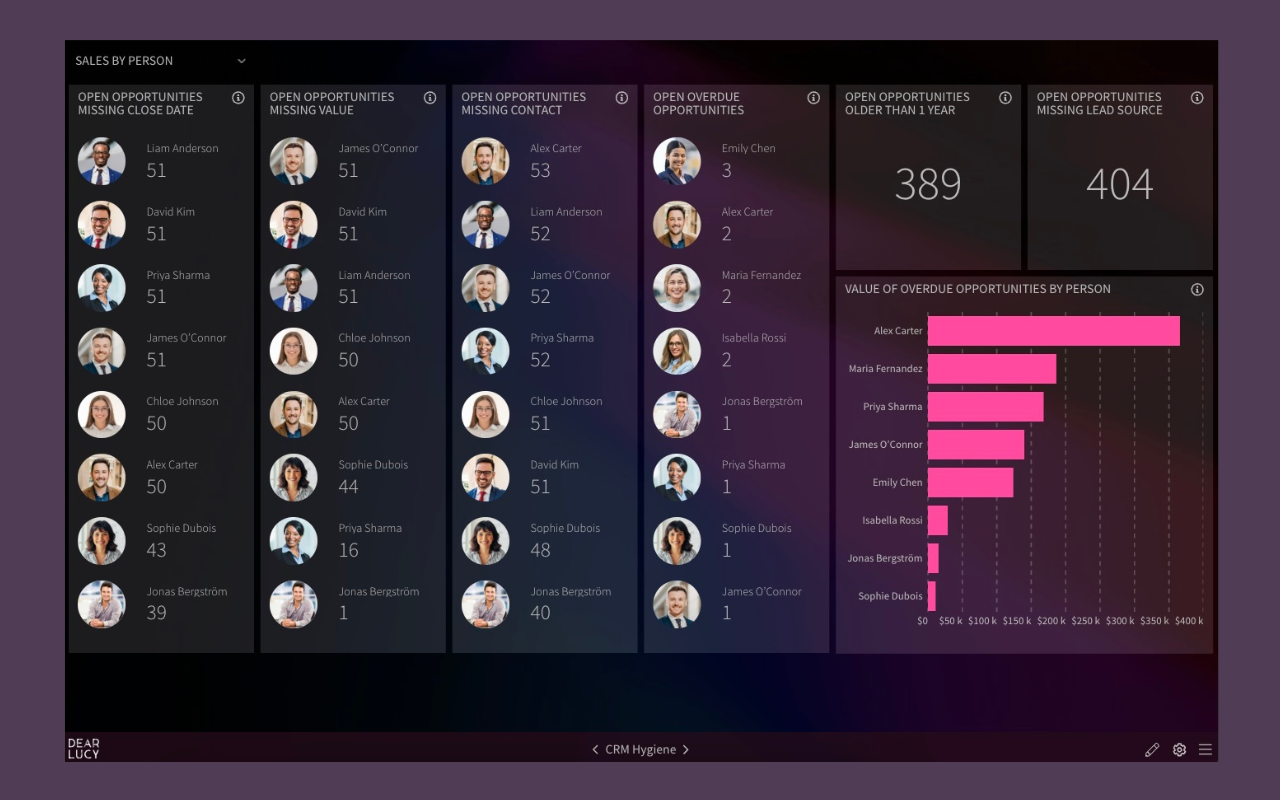
Salesforce CRM hygiene dashboard highlighting missing close dates, overdue opportunities, and incomplete deal data — used by revenue leaders to expose pipeline risk and improve forecast reliability.
This is why Salesforce data quality and forecast accuracy are inseparable. You can’t improve accuracy without exposing quality.
Teams that measure and review forecast accuracy continuously expose data quality issues early — before they show up in missed numbers.
Connect Salesforce. Dashboards appear automatically.
Why Salesforce data quality has become a board-level concern
In modern B2B companies, Salesforce data is no longer just for Sales Ops.
Boards and CFOs rely on Salesforce-based reporting to make decisions about:
hiring and headcount timing
investment pacing
cash flow planning
market and regional expansion
They don’t expect perfect forecasts.
They do expect predictability and transparency.
When forecasts miss without context, leadership can’t tell:
whether the miss was reasonable or avoidable
whether risk was visible early enough
whether forecasting behavior is improving or repeating
Poor Salesforce data quality removes that context — and credibility erodes fast.
Salesforce data quality is not a modeling problem — it’s a behavior problem
Most teams try to “fix” Salesforce data quality with rules, validation, or cleanup projects.
That rarely works.
Poor data quality isn’t caused by missing formulas.
It’s caused by how the CRM is used day to day.
Common Salesforce behaviors that damage data quality:
opportunities with outdated close dates
deals stuck in late stages without activity
inconsistent use of Commit vs Best Case
fields updated only right before forecast calls
pipeline that looks healthy but doesn’t convert
High-performing teams don’t treat data quality as a cleanup task.
They surface it continuously — tied directly to forecasting and execution.
While forecasting predicts outcomes, pacing and data quality show whether execution is converging on those outcomes. This is how modern teams run Salesforce forecasting in practice.
How strong revenue teams operationalize Salesforce data quality
Salesforce data quality improves when it’s visible, measurable, and owned.
High-performing revenue teams do three things differently:
1. They expose quality issues early — not at quarter end
Aging, slippage, and stalled deals are visible long before they become forecast misses.
2. They link CRM behavior to forecast credibility
If data quality drops, forecast confidence drops — automatically.
3. They review quality as part of the operating rhythm
Not as admin work, but as part of forecast calls and leadership reviews.
This shifts conversations from:
“Why did this miss?”
to
“Where is risk building right now?”
High-performing teams surface CRM hygiene continuously using dashboards built directly on Salesforce data.
Salesforce data quality and forecasting are two sides of the same system
Forecasting doesn’t fail because Salesforce lacks data.
It fails because leaders don’t know how much to trust it.
That’s why mature teams track:
pipeline aging
close date movement
stage progression
bias and slippage
forecast accuracy over time
Together, these turn Salesforce from a record system into a revenue control system.
If you want to see how leadership teams use this in practice, this connects directly to how modern teams run forecasting:
Why Salesforce alone often isn’t enough
Salesforce answers:
“What does the pipeline look like?”
Leadership needs to answer:
“How reliable is this pipeline — right now?”
That gap is why many teams still export Salesforce data into:
spreadsheets
decks
offline models
Not because Salesforce is broken — but because context and accountability are missing.
How revenue teams track Salesforce data quality in practice
With Dear Lucy, revenue teams surface Salesforce data quality automatically — without manual work.
The Salesforce Data Quality view shows:
deal aging and stagnation
close date drift
stage-level risk accumulation
forecast bias signals
breakdowns by team, region, or business unit
This gives CROs and CFOs a live view of CRM reliability — directly on Salesforce data.
It’s not about enforcing hygiene.
It’s about making behavior visible.
This is also why forecasting alone isn’t enough — execution needs to be paced and inspected between now and the close.
Want to see how this looks on your own pipeline?
Check your Salesforce data quality.
TL;DR: Salesforce data quality (for executives)
Salesforce data quality determines how much you can trust your numbers.
Strong revenue teams:
surface CRM quality continuously
link it directly to forecasting and execution
review it as part of leadership rhythm
If you can’t answer “How reliable is our Salesforce data right now?”
you’re flying blind — even if the pipeline looks strong.
FAQ: Salesforce data quality
What is Salesforce data quality?
Salesforce data quality reflects how accurate, current, and behaviorally reliable CRM data is — especially for forecasting and decision-making.
Why does Salesforce data quality matter for forecasting?
Forecast accuracy depends on deal progression, close dates, and stage integrity. Poor CRM behavior directly reduces forecast credibility.
What causes poor Salesforce data quality?
Outdated close dates, stalled deals, inconsistent forecast categories, and last-minute updates are the most common causes.
Who owns Salesforce data quality?
CROs own forecast credibility.
RevOps supports visibility.
Managers own CRM behavior within teams.
How do strong teams improve Salesforce data quality?
By making it visible in dashboards tied to forecasting — not through cleanup projects or manual enforcement.