

A practical guide to making better leadership decisions
Updated July 2026 · 9 minute read
In this guide you'll learn
Whether you're a CEO, CFO, Business Unit Leader or Sales Leader, this guide explains how high-performing professional services companies structure leadership meetings to make better business decisions.
You'll learn:
Why many leadership meetings fail to improve business performance.
How weekly, monthly, quarterly and annual leadership meetings should differ.
Which KPIs leadership teams should review at each stage.
Why targets create better leadership conversations than KPIs alone.
How Business Performance Management helps Sales, Finance and Operations work from the same view of the business.
Most Leadership Teams Don't Need More Reports
Every leadership team meets regularly. Some organisations meet every week, others monthly, and every company has its own rhythm for board meetings and annual planning. While the cadence varies, the purpose is always the same: to help leadership make better decisions about the business.
Yet many leadership meetings don't achieve that objective.
The agenda is full. Sales reviews pipeline, Finance presents the latest financial results, Operations reports on utilisation, and Business Unit Leaders explain what's happening in their own parts of the organisation. By the time everyone has shared their numbers, much of the meeting has already passed. Instead of discussing where the business should go next, the conversation often becomes an exercise in understanding what has already happened.
The problem is rarely a lack of information. Modern Professional Services Automation (PSA) platforms such as Visma Severa already provide excellent visibility into sales, projects, resources, billing and financial performance. As organisations grow, however, leadership teams need something more than operational reporting. They need a shared understanding of whether the business is on track, where management attention should be focused and which decisions will have the greatest impact over the coming weeks and months.
The strongest leadership teams don't spend their meetings collecting information. They arrive with a shared view of the business, allowing the conversation to focus on priorities, trade-offs and decisions. That's where leadership meetings begin creating real value.
Great Leadership Meetings Are About Decisions, Not Dashboards
Reporting is essential, but it is only the starting point.
A dashboard can show that revenue is below target, pipeline has improved or utilisation has fallen over the past month. Those insights are valuable, but they don't improve business performance on their own. Leadership performance improves when those insights lead to timely decisions and clear actions.
Every leadership meeting should therefore answer a simple question:
"Based on what we've learned today, what should we do differently?"
Perhaps a delayed customer project means recruitment should be postponed. Perhaps a stronger-than-expected sales pipeline justifies accelerating hiring. Perhaps one business unit needs additional support while another has developed practices worth adopting elsewhere.
These are leadership decisions. Reporting simply provides the evidence needed to make them with confidence.
The most effective leadership meetings don't end with everyone understanding the numbers. They end with everyone understanding what happens next.
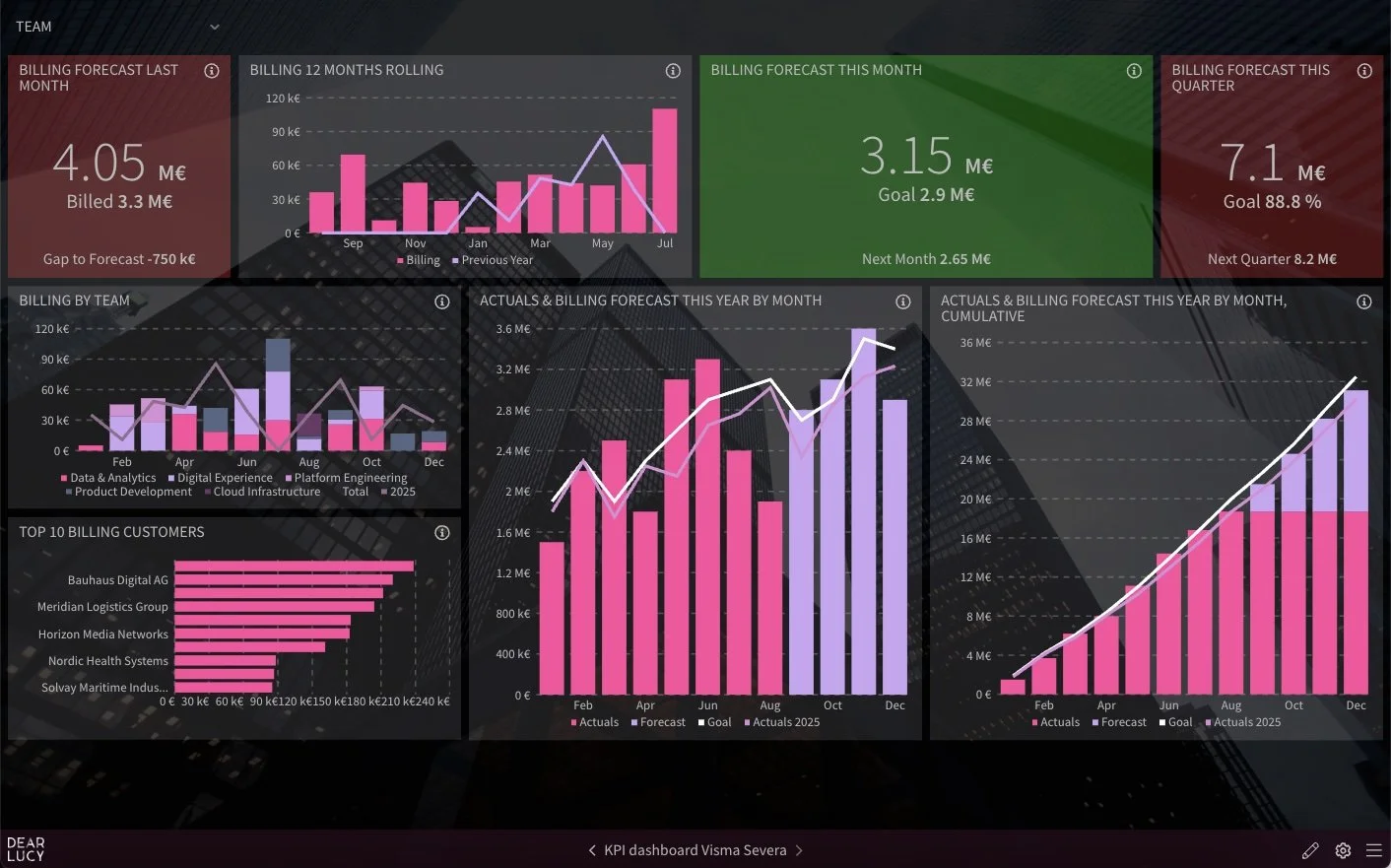
Example of a Business Performance Management dashboard built on operational data from Visma Severa. By combining actual performance, targets, forecasts and trends in one place, leadership teams can spend less time reconciling reports and more time making decisions.
Different Leadership Meetings Have Different Purposes
One reason leadership meetings become ineffective is that organisations often try to answer every business question in the same forum.
Weekly meetings drift into long-term strategy discussions. Board meetings become operational updates. Monthly business reviews focus on individual projects instead of business performance. Eventually, every meeting begins to look the same, even though each should serve a different purpose.
High-performing professional services companies structure leadership meetings around different time horizons.
Weekly leadership meetings focus on short-term execution. Their purpose is to identify emerging issues early, review changes in performance and agree on actions before small problems become larger ones.
Monthly business reviews step back and evaluate broader trends. Leadership reviews progress against targets, compares business units, assesses profitability and discusses whether the business is developing according to plan.
Quarterly board meetings take an even wider perspective. Rather than reviewing operational detail, they focus on strategic performance, long-term growth, investment decisions and the risks and opportunities that will shape the company's future.
Finally, annual planning establishes the targets, budgets and priorities that define success for the year ahead. Those decisions provide the framework for every leadership discussion that follows.
When each meeting has a clearly defined purpose, reporting becomes more focused, discussions become more productive and leadership spends less time preparing presentations and more time improving the business.
Every Leadership Meeting Should Answer the Same Five Questions
Although different meetings serve different purposes, the most effective leadership teams consistently begin with the same fundamental questions.
Are we on track?
Leadership needs to understand not only current performance but also whether the business is progressing towards its agreed targets. Reviewing actual results alongside targets and forecasts immediately provides the context needed to evaluate performance.
Are we building enough future business?
Today's sales activity determines tomorrow's revenue. Leadership should therefore understand whether pipeline, forecasts and new business development are sufficient to support the company's growth ambitions.
Are we delivering profitably?
Revenue alone rarely tells the full story. Sustainable growth depends on delivering projects efficiently, maintaining healthy utilisation and ensuring profitability develops as planned.
Where should leadership focus its attention?
Not every KPI deserves discussion. Leadership meetings create the greatest value when they quickly identify the few issues that genuinely require executive attention.
What should we do next?
Perhaps the most important question of all. Every leadership meeting should conclude with clear decisions, agreed owners and specific actions. The purpose of reporting is not to describe the business. It is to help leadership improve it.
Weekly Leadership Meetings: Focus on What Has Changed
Weekly leadership meetings should not become miniature board meetings.
Their purpose is not to review every KPI in detail or revisit long-term strategy. Instead, they should help leadership identify what has changed since the previous meeting and decide whether any action is required before the next one.
This shift in mindset makes an enormous difference. Rather than starting every meeting with a comprehensive review of the business, leadership begins by asking a much simpler question:
"What has changed since we last met?"
Perhaps the sales forecast has improved significantly. A major customer project may have been delayed, affecting next month's billing. One business unit may be consistently outperforming expectations while another is beginning to fall behind. These are the changes that deserve leadership's attention because they create opportunities—or risks—that require decisions.
Weekly meetings should therefore focus on a relatively small number of forward-looking indicators.
Leadership should understand whether revenue, billing and utilisation are developing according to plan, whether forecasts have changed, whether the sales pipeline remains strong enough to support future growth and whether any business unit requires additional support. The objective is not to review every KPI, but to identify the few developments that are likely to influence business performance over the coming weeks.
Just as importantly, every discussion should lead to a decision.
If forecasts have weakened, should recruitment be postponed? If pipeline has grown faster than expected, is it time to accelerate hiring? If one business unit is struggling to achieve its targets, what support does it need before the next leadership meeting?
These conversations are what separate reporting from management.
A good weekly leadership meeting rarely produces surprise presentations or lengthy discussions about historical performance. Instead, it provides leadership with enough shared understanding to make confident decisions quickly and ensure that the organisation remains on course.
High-performing leadership teams also resist the temptation to solve every operational issue themselves. If a topic can be resolved within a department, it should be. Weekly leadership meetings should focus on decisions that require cross-functional alignment or executive attention, allowing the leadership team to spend its time where it creates the greatest value.
At the end of every meeting, everyone in the room should be able to answer three simple questions:
What decisions did we make today?
Who owns each action?
What should be different before we meet again?
When leadership meetings consistently finish with clear answers to those questions, they become an integral part of how the business is managed rather than simply another recurring meeting.
Monthly Business Reviews: Understand the Trends Behind the Numbers
While weekly leadership meetings focus on immediate decisions, monthly business reviews should help leadership understand whether the business is developing in the right direction over time.
One month rarely tells the full story.
A delayed customer project may temporarily reduce billing. Holidays can affect utilisation. A major contract may move from one month to the next. Looking at individual months in isolation often creates unnecessary concern or, just as importantly, a false sense of confidence.
Monthly business reviews provide the opportunity to step back and look beyond short-term fluctuations. Rather than asking "What changed this week?", leadership should ask "Are we progressing according to plan?"
This is where targets become particularly valuable.
Revenue only becomes meaningful when compared with the expected revenue for that point in the year. Utilisation should be reviewed against realistic targets for each business unit, taking seasonality into account. Forecasts should be assessed not only by their current value but also by how consistently they have improved—or deteriorated—over recent months.
The discussion should also move beyond company-level performance.
As professional services organisations grow, leadership needs to understand how different parts of the business are performing. Comparing business units often reveals opportunities that would otherwise remain hidden. One team may consistently exceed its targets because it has developed more effective sales practices. Another may struggle with project profitability despite strong revenue growth. Understanding those differences helps leadership decide where to invest, where to provide support and which successful practices can be shared across the organisation.
Monthly business reviews are also an opportunity to challenge assumptions.
If a business unit has missed its billing target for three consecutive months, leadership should ask why. If forecast accuracy continues to improve, what has changed in the sales process? If utilisation remains high but profitability is declining, is the issue pricing, project delivery or resource allocation?
These conversations help leadership understand not only what is happening, but why it is happening.
Ultimately, the purpose of a monthly business review is not to produce another report. It is to identify trends early enough for leadership to influence the outcome before the next quarter. When these reviews consistently focus on progress against targets, emerging patterns and cross-functional learning, they become one of the most valuable leadership forums in the organisation.
Quarterly Leadership Reviews: Step Back and Look Ahead
By the end of each quarter, leadership should have a clear understanding of what has happened over the past three months. The purpose of a quarterly review is therefore not to repeat the discussions from weekly leadership meetings or monthly business reviews. Instead, it is an opportunity to step back, evaluate the broader direction of the business and ask whether the organisation is moving towards its long-term objectives.
This is where operational reporting gives way to strategic thinking.
Leadership should review whether revenue growth, profitability and new business are developing in line with the annual plan. Forecasts should be reassessed, not only to understand where the financial year is likely to end, but also to determine whether investment decisions, hiring plans or strategic priorities need to change.
Quarterly reviews are also an opportunity to look beyond the numbers themselves.
Why has one business unit consistently outperformed the rest of the organisation? Which strategic initiatives are delivering measurable results? Are there emerging market trends that require a different commercial approach? Has forecast accuracy improved, giving leadership greater confidence in future planning?
These questions rarely have immediate operational answers, but they often shape the direction of the business for months to come.
This is also the right moment to assess whether the organisation is measuring the right things. As companies grow, yesterday's KPIs may no longer reflect today's priorities. New service lines emerge, organisational structures evolve and strategic objectives change. Leadership should regularly ask whether its reporting still supports the decisions the business needs to make.
The most valuable quarterly reviews don't end with another presentation.
They end with a clearer understanding of where the business is heading, which strategic priorities deserve greater attention and whether the organisation remains on course to achieve its annual objectives.
Annual Planning Begins Long Before January
One of the biggest misconceptions about annual planning is that it starts when the budget process begins.
In reality, high-performing organisations prepare for next year throughout the current one.
Every weekly leadership meeting, monthly business review and quarterly strategic review provides new information about how the business is performing. Leadership learns which forecasts proved reliable, which targets were unrealistic, where capacity became constrained and which investments generated the greatest return. By the time annual planning begins, those lessons should already be well understood.
Annual planning is therefore much more than setting a revenue target.
Leadership should define what success will look like across the organisation and translate that vision into measurable objectives. Company targets provide strategic direction, while business unit, team and individual targets ensure that every part of the organisation understands how it contributes to achieving those objectives.
The strongest leadership teams also recognise that annual planning is not simply a financial exercise.
It is an opportunity to align strategy, operations and people around a common definition of success. When targets are clear from the beginning of the year and progress is reviewed consistently, leadership discussions become more objective, forecasting becomes more reliable and decision-making becomes significantly easier.
That is why annual planning should not be viewed as the end of one reporting cycle.
It is the starting point for every leadership conversation that follows.
The Best Leadership Teams Review Progress, Not Just Performance
One of the biggest differences between average and high-performing leadership teams is not the quality of their dashboards. It's the way they interpret the information those dashboards provide.
Many organisations review performance in absolute terms. Revenue increased. Utilisation fell. Pipeline improved. These observations are useful, but on their own they rarely tell leadership whether the business is actually succeeding.
High-performing organisations add another dimension to every discussion: progress against expectations.
Instead of asking whether revenue increased, they ask whether revenue is developing according to plan. Instead of reviewing pipeline in isolation, they assess whether it is sufficient to support the company's growth ambitions. Rather than discussing utilisation as a single percentage, they evaluate whether each business unit is performing against realistic targets that reflect its own circumstances.
That shift may appear subtle, but it changes the nature of leadership conversations completely.
The discussion moves away from explaining numbers and towards evaluating decisions. Leadership becomes less interested in what happened last month and more interested in whether the organisation is making progress towards its strategic objectives.
This is one of the reasons target management has become such an important part of Business Performance Management. Targets provide the context that transforms operational reporting into meaningful management information.
If you'd like to explore this topic in more depth, read our guide Why Every KPI Needs a Target: A Practical Guide for Professional Services Companies, where we explain how leading professional services companies structure targets across company, business unit, team and individual levels.
One Version of the Truth Changes Everything
Leadership meetings become remarkably efficient when everyone starts from the same understanding of the business.
Unfortunately, that isn't always the case.
As organisations grow, Sales, Finance and Operations naturally develop different perspectives. Sales focuses on pipeline and future revenue. Finance concentrates on financial performance and profitability. Operations monitors delivery, utilisation and resource planning. Each function is looking at the business through a different lens, often using different reports and sometimes even different definitions.
None of those perspectives is wrong.
The problem arises when leadership spends valuable meeting time reconciling numbers instead of discussing what they mean.
High-performing organisations solve this by establishing one shared management framework. Everyone reviews the same KPIs, measured in the same way, against the same targets and forecasts. Individual departments may continue using detailed operational reports, but leadership discussions begin from a common view of business performance.
This alignment creates benefits that extend well beyond reporting.
Forecasts become more reliable because Sales and Finance are working from the same assumptions. Business Unit Leaders understand how their performance contributes to company objectives. Discussions become more objective because success has already been defined before the meeting begins.
Perhaps most importantly, leadership meetings become significantly shorter.
When everyone trusts the numbers, the conversation quickly shifts from "Which report is correct?" to "What should we do next?"
That is one of the defining characteristics of mature Business Performance Management.
Frequently Asked Questions
How often should leadership teams meet?
Most high-performing professional services companies use several meeting rhythms rather than relying on a single leadership meeting. Weekly meetings focus on operational decisions, monthly reviews evaluate business performance against targets, quarterly meetings assess strategic progress, and annual planning establishes objectives for the year ahead.
What KPIs should CEOs review every week?
Weekly leadership meetings should focus on the KPIs most likely to influence near-term decisions. Typical examples include revenue against target, sales pipeline, revenue forecast, utilisation, business unit performance and any significant changes since the previous meeting. The objective is not to review every KPI, but to identify where leadership attention is needed.
How many KPIs should a leadership team review?
There is no universal number, but fewer is usually better. Leadership teams benefit from focusing on the KPIs that directly support business decisions rather than trying to review every available metric. Operational detail should remain within individual departments, while leadership meetings concentrate on the indicators that reflect overall business performance.
What is the difference between operational reporting and Business Performance Management?
Operational reporting explains what has happened across areas such as sales, projects, utilisation and finance. Business Performance Management builds on that information by combining operational data with targets, forecasts and executive reporting, helping leadership understand whether the business is on track and what actions should be taken next.
Should leadership meetings review actual performance or forecasts?
Both.
Actual performance explains where the business stands today, while forecasts help leadership understand where it is heading. Reviewing the two together allows leadership teams to identify risks earlier and make better decisions before financial results are affected.
Why do leadership meetings become less effective as organisations grow?
Growth increases complexity. More business units, more managers and more operational data often lead to different departments maintaining their own reports and perspectives. Without a shared management framework, leadership meetings can become focused on reconciling numbers rather than making decisions.
How does Visma Severa support leadership reporting?
Visma Severa provides the operational foundation for running a professional services business by bringing together projects, resources, CRM, time tracking and financial information. Many organisations extend that operational data with Business Performance Management to incorporate targets, forecasts and executive reporting, giving leadership a more complete view of business performance.
Better Leadership Meetings Start With Better Management Information
Every growing professional services company eventually reaches the point where operational reporting alone is no longer enough.
Not because the reports are inadequate.
And certainly not because the Professional Services Automation platform is the wrong choice.
The business has simply become more complex.
Leadership needs to understand not only what happened, but whether the organisation is on track, where management attention should be focused and which decisions will have the greatest impact on future performance.
That is where Business Performance Management builds on operational reporting.
If you'd like to explore the wider discipline of Business Performance Management, including forecasting, executive reporting and performance frameworks, read our Ultimate Guide to Business Performance Management with Visma Severa.
For many professional services companies, Visma Severa already provides the operational foundation by bringing together projects, resources, CRM, time tracking and financial information in a single platform. Business Performance Management extends that foundation by combining operational data with targets, forecasts and executive reporting, giving leadership a consistent framework for making decisions.
Operational systems help teams run the business.
Business Performance Management helps leadership run the company.
The two are complementary.
Final Thoughts
The quality of a leadership meeting is rarely determined by the agenda or the dashboards displayed on the screen.
It is determined by the quality of the decisions that are made.
High-performing leadership teams don't spend their meetings debating numbers. They begin with a shared understanding of business performance, review progress against clearly defined targets and focus their time on the decisions that will improve future results.
That doesn't require more KPIs.
It requires better management information.
As organisations grow, leadership meetings become one of the most important management processes in the business. When they are supported by trusted operational data, meaningful targets and reliable forecasts, they become significantly more than a recurring calendar invitation.
They become one of the company's greatest competitive advantages.
Continue Your Reading
If you're looking to build a more structured approach to Business Performance Management, these guides explore the topic in more detail.
📖 The Ultimate Guide to Business Performance Management with Visma Severa
Learn how professional services companies combine operational reporting, target management, forecasting and executive reporting into a single management framework.
📖 Why Every KPI Needs a Target: A Practical Guide for Professional Services Companies
Discover why high-performing organisations define success before they measure performance.
→ Read Why Every KPI Needs a Target
Bringing This Approach to Your Leadership Team
If you're using Visma Severa and would like to bring targets, forecasts and executive reporting into your leadership meetings, learn how Dear Lucy extends your operational reporting with Business Performance Management.