

How high-performing professional services companies use target management to make better business decisions.
In this guide you'll learn
Whether you're a CEO, CFO, Business Unit Leader or Operations Leader, this guide explains why high-performing professional services companies don't just measure KPIs—they manage performance against clearly defined targets.
You'll learn:
Why most organisations don't have a KPI problem—they have a target management problem.
Why annual budgets are not enough to manage a growing professional services business.
How leading professional services companies structure targets across the organisation.
Which KPIs leadership teams should review—and, more importantly, how they should review them.
Why target management leads to better leadership conversations.
How Business Performance Management builds on the operational foundation provided by systems such as Visma Severa.
Most Professional Services Companies Don't Have a KPI Problem
Modern professional services businesses have no shortage of performance data. Revenue, billing, utilisation, project profitability and sales performance are readily available through Professional Services Automation (PSA) platforms such as Visma Severa, making operational reporting easier than ever.
As organisations grow, however, leadership meetings begin to change. The discussion shifts away from producing reports and towards making decisions.
Questions such as Are we on track? Which business unit needs attention? Can we still achieve our annual objectives? Should we recruit now—or wait another month? become far more important than simply understanding what happened last month.
Operational reporting alone cannot answer these questions because they require something more than accurate numbers. They require a shared understanding of what success looks like.
The challenge isn't measuring performance. It's agreeing what good performance looks like.
That is the role of target management.
Reporting Tells You What Happened. Target Management Helps You Decide What Happens Next.
A typical leadership meeting includes financial reporting from Finance, pipeline updates from Sales and operational metrics from Delivery. Individually, every report is accurate. Collectively, they still leave the CEO asking one question:
Are we where we expected to be?
Operational KPIs describe performance, but they rarely evaluate it.
Revenue of €2.4 million might represent an outstanding month if the target was €2.2 million—or a disappointing one if leadership expected €2.7 million.
A utilisation rate of 76% may be excellent for one business unit and below expectations for another.
Pipeline growth can appear healthy while still falling short of what is needed to achieve next quarter's revenue target.
Leadership rarely needs more KPIs. It needs better context.
Targets provide that context. They allow leadership to distinguish between performance that simply looks good and performance that is genuinely moving the business towards its strategic objectives.
Business Performance Management doesn't replace reporting. It builds on it by giving every KPI a clear definition of success.
Growth Changes the Way Leadership Measures Success
In smaller organisations, target management is often informal. Leadership is close enough to customers, projects and employees that performance can be assessed through regular conversations rather than structured management processes.
As organisations grow, that changes.
As new business units emerge and management responsibilities become distributed, company-level reporting is no longer sufficient. Leadership needs to understand performance at company, business unit, team and, in some cases, individual level—not because more reports are needed, but because responsibility has become distributed across the organisation.
The objective is no longer simply to understand how the business is performing. It is to understand where performance is strongest, where it is falling behind and where leadership attention will have the greatest impact.
This is the point where target setting stops being part of the annual budgeting process and becomes part of how the business is managed.
Why Annual Budgets Aren't Enough
Every well-managed professional services business has an annual budget. It sets strategic direction, supports investment decisions and aligns the organisation around shared financial objectives.
The challenge is that while budgets are approved annually, businesses are managed continuously. Recruitment decisions are made throughout the year, sales forecasts evolve every week, projects start and finish at different times, and customer demand changes as markets change. Leadership cannot afford to wait until December to discover whether the business is still on track.
An annual budget provides direction, but it doesn't provide day-to-day management.
This is where many organisations unintentionally create a gap between planning and execution. The annual budget exists. Operational reporting exists. What's often missing is a management layer that continuously measures progress against plan, helping leadership understand not only how the business is performing, but whether it is performing as expected.
Professional Services Businesses Are Not Linear
Professional services businesses rarely perform evenly throughout the year.
Every leadership team knows this instinctively. Consultants take annual leave, public holidays reduce billable capacity, projects begin and end, recruitment temporarily affects utilisation before new employees become fully productive, and customer purchasing patterns fluctuate throughout the year.
An engineering consultancy may complete several major projects before the summer, creating an exceptionally strong second quarter. A creative agency may experience a quieter July followed by a very busy autumn. A consulting firm may deliberately invest in recruitment during one quarter, knowing that utilisation will recover as new consultants become fully billable.
None of these situations is unusual. They are a normal part of running a professional services business.
Yet many organisations still compare every month against identical expectations.
Leadership knows that July should not be measured in the same way as March.
Target management should recognise that reality.
Monthly targets should reflect seasonality. Quarterly targets should reflect business priorities. Annual objectives should remain the strategic destination—not the only benchmark against which performance is measured.
That's why many organisations set different billing or revenue targets for every month instead of repeating the same target twelve times.
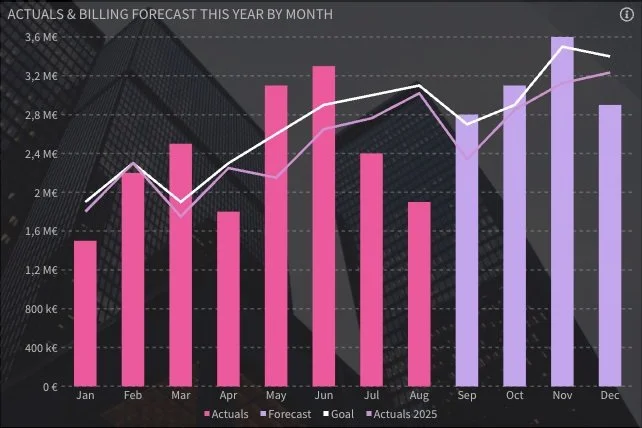
Monthly targets should reflect seasonality. Comparing actual performance, forecasts and targets helps leadership identify trends before they become business problems.
Good Targets Create Better Decisions
The purpose of target management is not to create more reports. It is to improve the quality of leadership decisions.
Consider a Business Unit Leader reviewing monthly billing. Without a clear target, the discussion quickly becomes subjective. Billing feels lower than expected. The month was quieter than usual. The team expects to recover next month. Those observations may all be true, but they rarely provide a sound basis for decision-making.
Now consider the same discussion with agreed targets.
Billing finished 6% below plan because two customer projects started later than expected. The sales pipeline remains healthy, and current forecasts indicate that the shortfall will be recovered next month. No corrective action is required beyond monitoring the situation.
The business hasn't changed, and neither has the underlying information. What has changed is the quality of the leadership discussion.
Good target management doesn't eliminate uncertainty. It replaces assumptions with facts, allowing leadership teams to make decisions with greater confidence.
Set Targets at Company, Business Unit, Team and Individual Level
As organisations grow, company-wide targets become increasingly important—but increasingly insufficient.
A CEO needs confidence that the business as a whole is progressing according to plan. A Business Unit Leader needs visibility into the performance of their own organisation. Sales leaders focus on future revenue, while Delivery managers are responsible for utilisation, billing and project profitability.
Each role contributes to the same strategic objectives, but through different levers.
This is why high-performing organisations don't rely on a single company-wide target. Instead, they align targets across the organisation.
Company targets define strategic direction.
Business unit targets create accountability.
Team targets help managers prioritise work.
Individual targets clarify how each employee contributes to broader business objectives.
When these layers are connected, leadership no longer manages isolated teams. It manages one organisation moving towards shared goals.
That alignment is one of the defining characteristics of mature Business Performance Management.
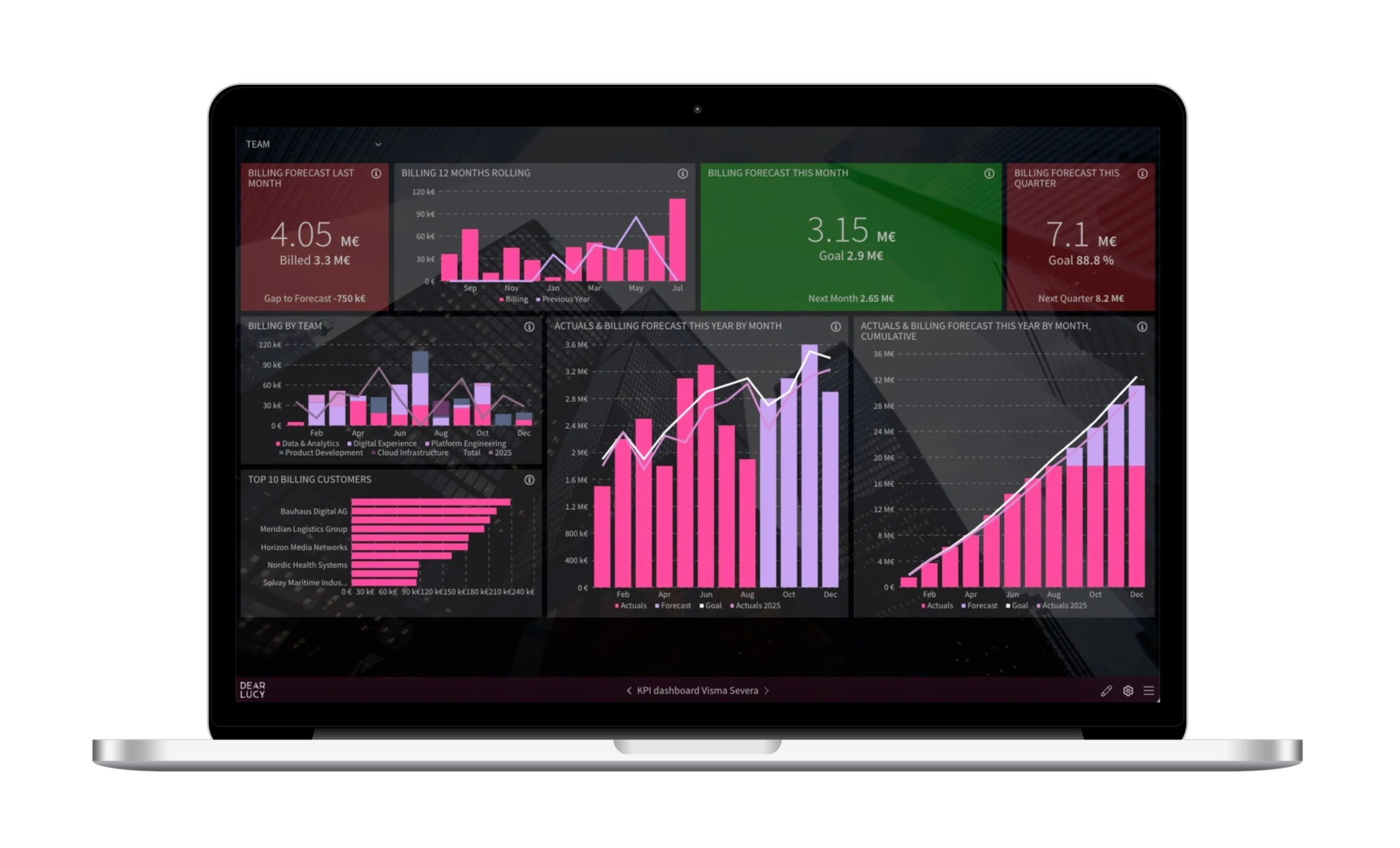
Modern Business Performance Management combines targets, forecasts and KPIs in one executive dashboard built on top of Visma Severa.
The Best Leadership Teams Review Progress, Not Just Results
Most leadership teams already review KPIs.
The strongest leadership teams review something more valuable: progress against expectations.
That distinction fundamentally changes the conversation.
Revenue becomes revenue against target.
Billing becomes billing against budget.
Utilisation becomes utilisation against the expected level for that team.
Pipeline becomes pipeline against future revenue objectives.
The KPI itself hasn't changed.
Its meaning has.
A target transforms a KPI from a measurement into a management tool.
This simple shift moves leadership discussions away from reporting and towards decision-making. Instead of asking "What happened?", leadership begins asking "Are we where we expected to be?" and, more importantly, "What should we do next?"
That is the point at which reporting stops being a monthly exercise and becomes part of the company's management rhythm.
If you're interested in how high-performing professional services companies structure weekly, monthly and quarterly leadership meetings around these principles, read our guide How High-Performing Professional Services Companies Run Leadership Meetings.
What Leadership Teams Should Review Every Month
Every leadership team develops its own reporting rhythm.
An engineering consultancy doesn't review exactly the same metrics as a creative agency. A company focused on rapid growth will naturally pay more attention to commercial performance than a mature business optimising profitability.
Even so, the most effective leadership teams tend to review performance through the same four lenses.
Rather than asking dozens of disconnected questions, they focus on a small number of indicators that explain how the business is performing today—and where it is likely to be tomorrow.
Financial Performance: Are We Delivering the Business We Planned?
Financial reporting should do more than explain last month's results. Its primary purpose is to help leadership understand whether the business is developing as planned.
Revenue, billing and profitability remain the foundation of every leadership review, but none of these metrics should be considered in isolation. A revenue increase may still fall short of expectations. Strong billing may hide weakening profitability. One business unit may be outperforming while another quietly drifts behind plan.
The objective is therefore not simply to review financial performance, but to understand whether the business is progressing towards its strategic objectives.
Questions worth asking include:
Is revenue developing in line with our targets?
Which business units are ahead of plan—and which require attention?
Are margins evolving as expected?
Do current trends suggest we'll achieve our annual objectives?
Leadership should always review trends alongside current performance. A single month rarely tells the whole story, but trends often reveal opportunities and risks long before they become visible in the annual accounts.
Operational Performance: Are We Using Our Capacity Effectively?
For a professional services company, people are the business.
How effectively consultants, specialists and project teams convert their time into customer value ultimately determines the organisation's financial performance.
Utilisation is therefore one of the industry's most important KPIs, but it should never be viewed in isolation. High utilisation is valuable only if it supports healthy margins, sustainable workloads and successful project delivery.
Leadership should evaluate operational performance as a whole, combining measures such as utilisation, billable hours, average hourly rate, customer work percentage and project profitability into a single picture of organisational health.
The objective isn't maximum utilisation.
It's sustainable, profitable growth.
Commercial Performance: Are We Creating Enough Future Revenue?
Financial reporting explains where the business has been.
Commercial reporting provides an indication of where it is going.
For many professional services firms, today's commercial performance determines revenue several months from now. Pipeline coverage, new business, revenue forecasts and win rates therefore deserve the same level of attention as historical financial results.
Rather than reviewing sales activity in isolation, leadership should ask a broader question:
Does today's commercial performance give us confidence that we'll achieve tomorrow's business objectives?
That single question naturally brings together pipeline, new business, revenue forecasts and forecast quality into one leadership discussion.
Where Should Leadership Focus Its Attention?
As organisations grow, company-level reporting becomes less useful on its own.
A single revenue figure cannot explain why one business unit consistently exceeds its targets while another struggles to achieve similar results. Nor does it tell leadership where its attention will have the greatest impact.
High-performing organisations therefore compare performance across business units, teams and service lines—not to rank them, but to understand where support, investment or intervention is needed.
Leadership discussions become far more valuable when they focus on questions such as:
Which business units are consistently outperforming expectations?
Where has performance changed significantly since last month?
Which teams need additional support?
What explains the differences?
What can we learn from our strongest-performing teams?
These conversations are rarely driven by individual KPIs.
They are driven by understanding where the business is ahead of plan, where it is falling behind and where leadership attention can make the biggest difference.
The Most Valuable Measure Is Progress Against Target
Leadership rarely struggles because it lacks information. The real challenge is deciding where to focus.
Every KPI competes for attention. Targets provide the context that helps leadership distinguish between performance that simply looks acceptable and performance that genuinely requires action.
When performance is reviewed against agreed expectations, discussions become shorter, more objective and considerably more productive.
Instead of asking "What happened?", leadership begins asking "Where do we need to act?"
A target transforms a KPI from a measurement into a management tool.
That is one of the fundamental principles of Business Performance Management.
From Operational Reporting to Business Performance Management
Every growing professional services company eventually reaches a point where operational reporting is no longer enough.
Not because operational reports are inadequate.
And certainly not because the Professional Services Automation platform is the wrong choice.
The business has simply become more complex.
Leadership questions become more strategic. The CEO wants confidence that the company is progressing towards its annual objectives. Business Unit Leaders need visibility into the performance of their own teams. Sales wants to know whether today's pipeline will support tomorrow's revenue. Finance needs forecasts that are reliable enough to support investment and recruitment decisions.
These questions build on operational reporting rather than replacing it.
For many professional services companies, Visma Severa already provides the trusted operational foundation for running the business by bringing together projects, CRM, resources, time tracking and financial information. Business Performance Management simply builds on that foundation, helping leadership turn trusted operational data into targets, budgets, forecasts and executive reporting.
Operational systems help you run the business. Business Performance Management helps leadership run the company.
The two are complementary.
Dear Lucy is an official Visma Severa integration, allowing organisations to extend Severa with Business Performance Management while continuing to use Severa as their operational system.
Signs Your Organisation Has Outgrown Traditional Target Management
Organisations rarely decide overnight that they need a more structured approach to target management.
More often, the need becomes apparent through small frustrations that appear as the business grows.
You may recognise some of these situations:
Your annual budget is approved, but rarely revisited during the year.
Business Unit Leaders maintain their own Excel target sheets because company-level reporting isn't enough.
July appears to underperform every year, even though everyone understands the impact of holidays and reduced capacity.
Board meetings begin by reconciling different reports instead of discussing business decisions.
Leadership spends more time explaining performance than deciding what to do next.
Sales, Finance and Operations all trust their own numbers—but not always each other's.
None of these are signs of poor leadership.
They are signs that the organisation has reached a new stage of maturity.
As businesses grow, management processes must evolve alongside them.
Target management is one of those processes.
Great Leadership Teams Create Alignment Before They Create Reports
One of the biggest misconceptions about reporting is that better dashboards automatically lead to better decisions.
They don't.
Better decisions come from shared understanding.
When targets are clearly defined, leadership spends less time validating numbers and more time discussing priorities. Business unit reviews become more objective. Coaching becomes easier because managers can discuss progress against agreed expectations rather than personal opinions. Sales, Finance and Operations begin making decisions using the same performance framework.
This is why mature organisations rarely ask for more reports.
They ask for better management information.

Business Performance Management gives every leadership team one trusted view of performance, helping meetings focus on decisions rather than reconciling reports.
Final Thoughts
Most professional services companies already measure the right KPIs.
The organisations that consistently outperform their peers do something different.
They define success before they measure performance.
Targets provide context for every KPI. They align leadership around shared objectives, help managers identify where attention is needed and enable better decisions long before issues become visible in the financial results.
That is why target management matters.
Not because it creates more data.
Because it helps leadership make better decisions.
For many professional services companies, Visma Severa provides the trusted operational foundation for running projects, resources and day-to-day operations. Business Performance Management builds on that foundation by combining operational reporting with targets, forecasts and executive reporting, giving leadership a clearer understanding of where the business is today—and where it is heading.
Ultimately, competitive advantage rarely comes from having more reports.
Business Performance Management isn't about measuring the business. It's about running it better.
Related Reading
Target management is one of the core disciplines of Business Performance Management.
To learn how leading professional services companies combine operational reporting, target management, forecasting and executive reporting, read our comprehensive guide:
The Ultimate Guide to Business Performance Management with Visma Severa
If you're evaluating how to manage targets, budgets and business performance in Visma Severa, explore how Dear Lucy extends Severa with Business Performance Management.
→ Explore Dear Lucy for Visma Severa
Frequently Asked Questions
Why isn't measuring KPIs enough?
KPIs tell you how the business is performing. Targets provide the context that helps leadership understand whether performance is meeting expectations and where action is needed.
What's the difference between a KPI and a target?
A KPI measures business performance, such as revenue, utilisation or billable hours. A target defines the level of performance the organisation expects to achieve over a given period.
Should every KPI have a target?
Not necessarily. Focus on the KPIs that are directly linked to your strategic objectives and management decisions. In most professional services businesses, these include revenue, billing, utilisation, profitability, sales pipeline and new business.
Why shouldn't every month have the same target?
Professional services businesses are seasonal. Holidays, recruitment, project delivery and customer demand all affect monthly performance. Monthly targets should reflect those expected variations rather than applying the same target throughout the year.
Can different teams have different targets?
Yes. High-performing organisations typically set targets at company, business unit, team and individual level. While everyone contributes to the same strategic objectives, each part of the organisation is responsible for different outcomes.
How does Business Performance Management build on Visma Severa?
Visma Severa provides the operational data needed to run projects, manage resources and track financial performance. Business Performance Management builds on that foundation by combining operational reporting with targets, forecasts and executive reporting to help leadership make better decisions.