
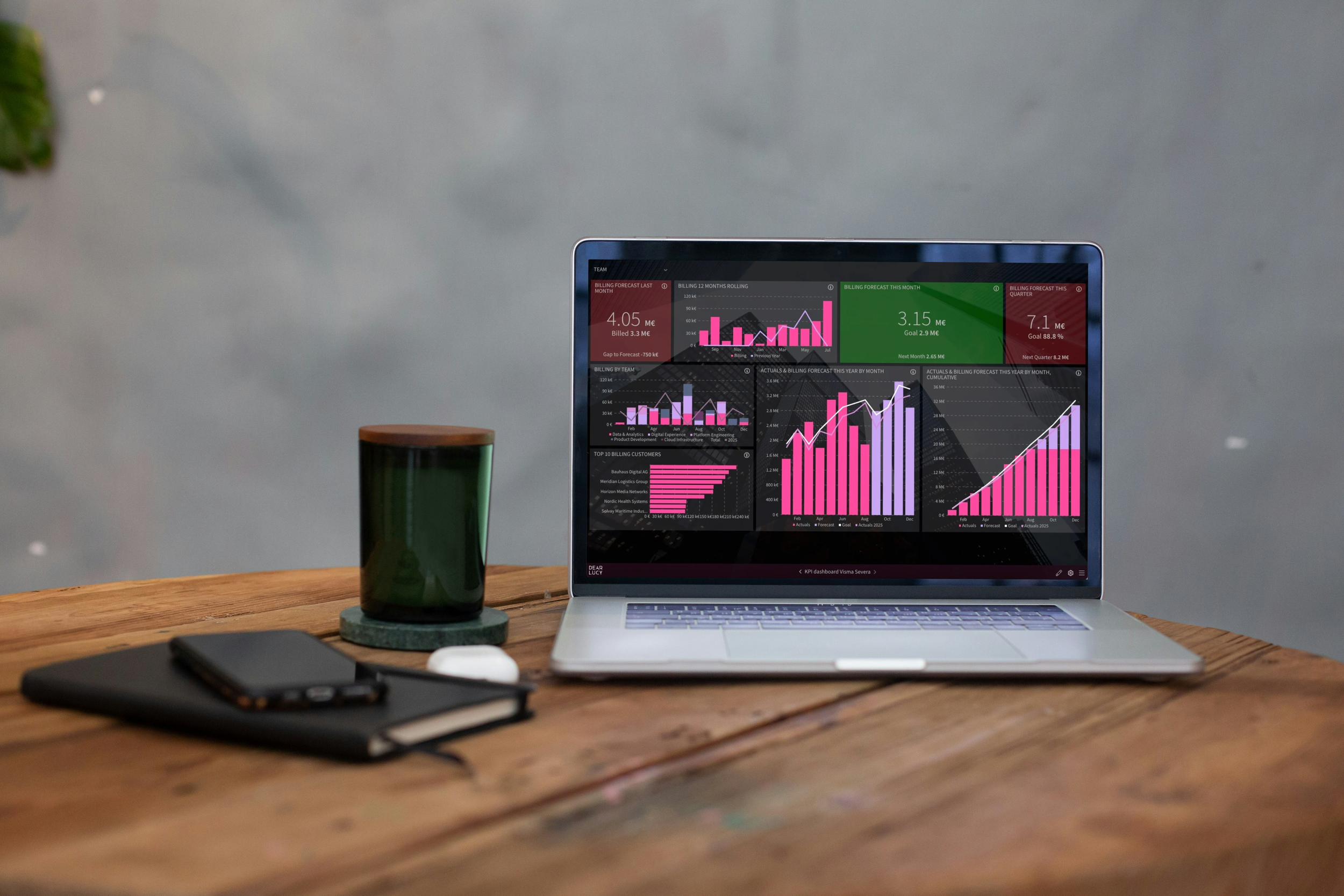
How growing professional services companies use KPIs, targets, forecasting and executive reporting to make better business decisions.
Whether you're a CEO, CFO, Business Unit Leader or Sales Leader, this guide explains how growing professional services companies use Visma Severa data to improve business performance.
In this guide you'll learn
What Business Performance Management is—and how it differs from reporting
The five questions every leadership team should answer every week
The KPIs that matter most for professional services companies
How to manage performance against targets
How leadership meetings drive better business decisions
How reporting evolves as your business grows
Answers to frequently asked questions
As Professional Services Companies Grow, Leadership Changes
In the early days, running a professional services business feels surprisingly straightforward. Leadership knows every customer, sales and delivery work closely together, projects are easy to oversee, and finance can close the books quickly. Everyone has a good sense of how the business is performing because the organisation is still small enough to stay connected.
As the company grows, that simplicity gradually disappears. More consultants join, projects become more complex, new business units are created and management responsibilities become distributed. At the same time, the volume of operational data increases dramatically.
Ironically, having more data rarely makes leadership decisions easier.
Sales has one view of the business, Finance another. Business Unit Leaders often maintain their own reports to answer the questions most relevant to their teams. By the time the leadership team meets, everyone has prepared their numbers—but not everyone is working from the same version of the truth.
Instead of discussing where the business should go next, leadership meetings can easily become exercises in reconciling reports and explaining why different numbers don't quite match.
At first glance, this looks like a reporting problem.
In reality, the reports aren't the problem.
The missing piece is Business Performance Management.
Visma Severa Already Gives You a Strong Operational Foundation
Visma Severa is one of the leading Professional Services Automation (PSA) platforms for consulting, engineering, architecture, creative agencies and other project-based businesses.
It brings together the operational side of a professional services business in one place:
CRM
Projects
Resource planning
Time tracking
Invoicing
Financial information
For managing day-to-day operations, this is exactly what growing professional services businesses need.
As organisations grow, leadership begins asking different questions.
Operational data alone doesn't answer questions like:
Are we on track to reach our annual revenue target?
Which business unit is performing best?
Which teams need attention before the end of the quarter?
Are our forecasts becoming more accurate?
Will current pipeline support next quarter's growth?
Are Sales, Finance and Operations working from the same numbers?
Answering those questions requires something more than operational reporting.
It requires business performance management.
What is Business Performance Management?
Business Performance Management helps leadership turn operational data into better business decisions.
Reporting tells you what happened.
Business Performance Management helps leadership understand:
whether the business is on track
why performance is changing
what is likely to happen next
where attention is needed most
which actions will improve results
Think about the difference.
A report might tell you:
Revenue this month was €2.4 million.
Business Performance Management tells you:
Revenue target is €2.6 million.
Current forecast is €2.5 million.
One business unit is already exceeding plan.
Another is likely to miss its quarterly target.
Forecast accuracy has improved by 12% during the last six months.
Those lead to completely different conversations.
One reports history.
The other helps leaders improve the future.
Reporting Tells You What Happened. Business Performance Management Helps You Decide What Happens Next.
Many organisations spend enormous effort producing reports.
Far fewer spend the same effort deciding what to do with them.
The purpose of reporting is not to create dashboards.
The purpose of reporting is to improve business performance.
That shift in thinking changes everything.
Instead of asking:
“What happened last month?”
Leadership begins asking:
Are we winning?
Where are we falling behind?
Which trends matter?
What decisions should we make today?
That's where reporting becomes management.
The Five Questions Every Leadership Meeting Should Answer
Every KPI, report and dashboard should help leadership answer these five questions. If they don't, they're probably measuring the wrong things.
The best leadership teams don't review hundreds of KPIs.
They answer five simple questions.
If those questions are answered consistently, the business is usually heading in the right direction.
Everything else is detail.
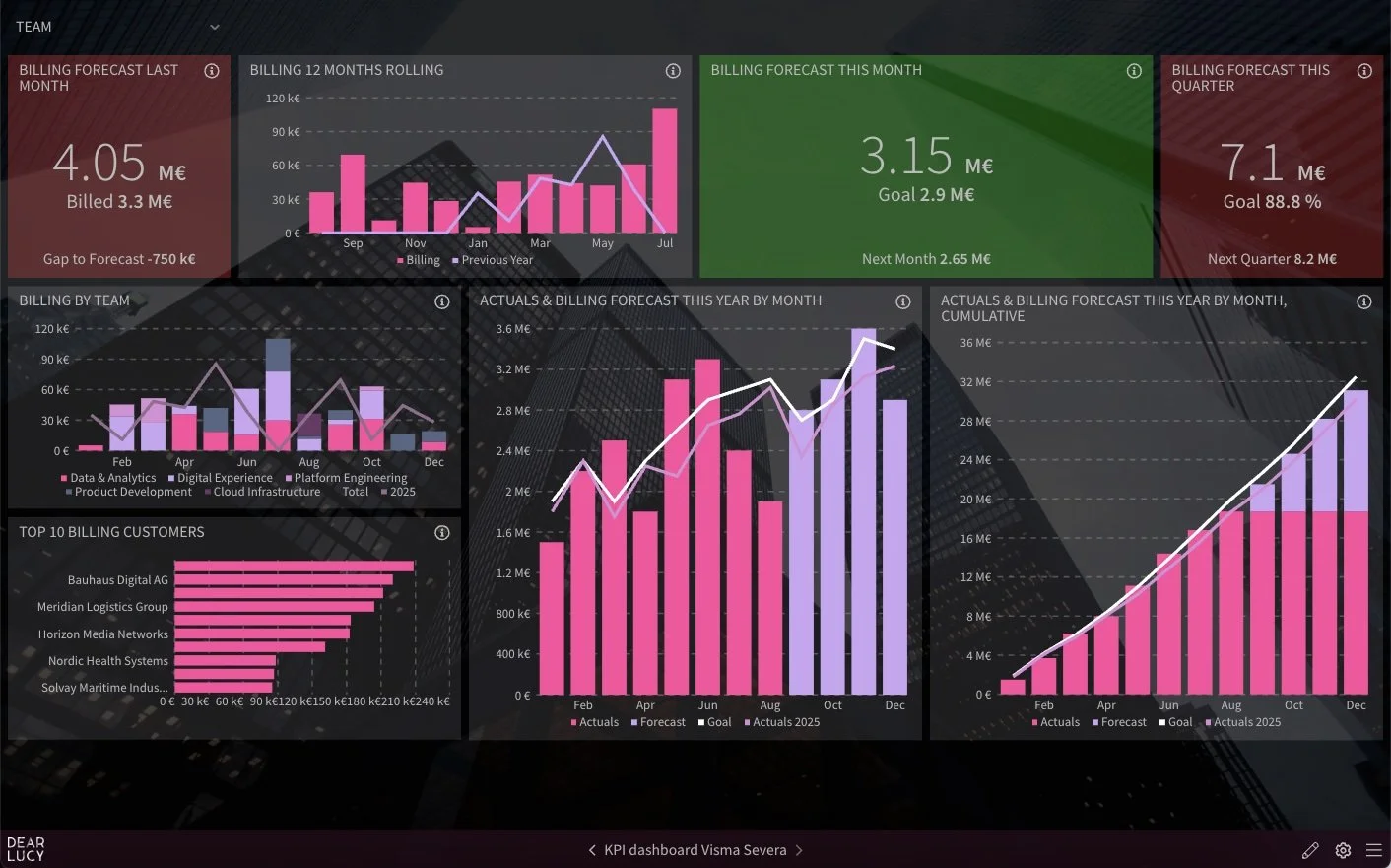
Example Business Performance Management dashboard combining revenue, billing, targets and forecasts for executive decision-making.
1. Are we on track?
This is the first question every leadership team should answer.
The question isn't simply how much revenue you've generated. It's whether the business is performing as expected.
Instead:
"Are we on track to achieve our goals?"
Leadership needs to see four numbers together:
Actual revenue
Revenue target
Current forecast
Previous year's performance
Revenue only becomes meaningful when it's viewed in context.
Performance only becomes meaningful when it's measured against a target.
2. Are we selling enough?
Revenue six months from now is largely determined by today's sales activity.
Leadership needs visibility into future revenue, not just historical results.
Leadership should regularly ask:
Is our pipeline large enough?
Are we winning enough opportunities?
How accurate are our forecasts?
Which business units have healthy pipeline coverage?
Strong forecasting gives leadership time to act before problems appear.
Weak forecasting only explains why they happened.
3. Are we delivering profitably?
Winning work is only half the equation.
Sustainable growth depends on delivering projects efficiently and profitably.
Leadership should continuously review:
Utilisation
Billable rate
Billing
Project profitability
Gross margin
None of these metrics tells the full story on its own.
High utilisation doesn't automatically mean a healthy business.
Neither does revenue growth.
The objective is sustainable, profitable growth.
4. Where should leadership focus?
One of the biggest mistakes leadership teams make is assuming every KPI deserves equal attention.
It doesn't.
A growing professional services business generates thousands of data points every day. Trying to monitor all of them creates noise rather than clarity.
Great leadership teams don't try to manage everything.
They identify the few areas where leadership attention will have the greatest impact.
That means asking questions like:
Which business unit is drifting furthest from its targets?
Which forecasts have changed significantly since last week?
Which teams consistently outperform the rest of the business?
Which customers or projects deserve closer attention?
Where are the biggest opportunities to improve results?
Business Performance Management isn't about measuring everything.
It's about knowing where leadership attention creates the greatest value.
5. What should we do next?
This is where reporting becomes management.
Every leadership meeting should finish with decisions, not dashboards.
Good reporting doesn't just describe the business.
It drives action.
Example 1
Pipeline is healthy, but forecast accuracy is declining.
→ Improve sales qualification instead of increasing lead generation.
Example 2
Revenue is on target, but utilisation has dropped.
→ Review resource planning and delivery capacity.
Example 3
One business unit consistently outperforms the others.
→ Understand why and replicate those practices elsewhere.
The value isn't in seeing the numbers.
The value is changing what happens next.
Business Performance Management Checklist
Can you answer instantly:
✓ Are we on target?
✓ Is our forecast reliable?
✓ Which business unit needs attention?
✓ Are Sales and Finance using the same numbers?
✓ What action should leadership take next?
The KPIs Every Professional Services Company Should Track
Every professional services business is different, but the most successful leadership teams consistently monitor the same core indicators.
The goal isn't to measure everything.
The goal is to measure what drives better decisions.
Revenue
Revenue is still the single most important indicator of business growth.
However, actual revenue should always be viewed alongside targets, forecasts and previous performance.
Revenue only becomes meaningful when it's viewed in context.
Compare revenue against:
target
forecast
previous year
Billing
For project-based businesses, billing is just as important as revenue.
Sales may have signed new business.
Projects may already be underway.
But delayed invoicing can quickly affect cash flow and financial performance.
Comparing billing against budgets and forecasts helps leadership identify issues before they become financial problems.
Forecast
Forecasting is one of the biggest competitive advantages a growing business can develop.
A reliable forecast allows leadership to:
recruit confidently
invest at the right time
identify risks earlier
communicate with confidence
Forecasts should never be static monthly exercises.
They should evolve continuously as new opportunities, projects and risks emerge.
Forecast Accuracy
Many organisations create forecasts.
Very few measure whether those forecasts are actually accurate.
Forecast accuracy is one of the strongest indicators of commercial maturity.
If forecasts are consistently optimistic, leadership will repeatedly make poor hiring and investment decisions.
Improving forecast accuracy often delivers more value than simply improving forecasting.
Pipeline Coverage
One simple question often reveals future revenue risk.
Do we have enough qualified pipeline to achieve next quarter's targets?
Pipeline coverage provides an early warning system.
Leadership gains time to react before revenue problems become visible in financial results.
Win Rate
Pipeline alone doesn't generate growth.
Winning opportunities does.
Reviewing win rates by business unit, salesperson and service line often reveals opportunities to improve revenue without increasing marketing spend.
Utilisation
Utilisation has long been one of the most important operational metrics in professional services.
However, high utilisation doesn't automatically mean high performance.
Leadership should always evaluate utilisation alongside profitability, billing and revenue.
High utilisation is valuable only if it contributes to profitable growth.
The goal is sustainable performance, not maximum utilisation.
Project Profitability
Revenue growth creates value only when projects remain profitable.
Tracking profitability by project, customer, service line and business unit helps leadership understand where the business creates the greatest value.
It also highlights where pricing, delivery or project execution should improve.
KPI Trends
Perhaps the most valuable KPI isn't a KPI at all.
Trends reveal far more than individual months ever can.
One month's revenue says very little.
Six months of revenue tells a story.
The same applies to utilisation, profitability, forecasts and target attainment.
High-performing leadership teams focus on trends rather than isolated monthly numbers.
That's where better decisions come from.
Target Attainment
Not revenue.
Not target.
Target attainment.
Example:
Target attainment measures how consistently teams achieve the goals set for them.
Leadership should be able to monitor target attainment at company, business unit, team and individual level.
KPIs Without Targets Only Tell Half the Story
Most organisations already measure performance.
Far fewer define what success actually looks like.
A KPI without a target answers one question.
“What happened?”
A KPI compared against a target answers a much more valuable one.
“Are we winning?”
That distinction changes the way leadership manages the business.
Revenue → Revenue vs Target
Forecast → Forecast vs Target
Billing → Billing vs Budget
Utilisation → Utilisation vs Goal
Leadership stops reviewing history.
Leadership starts managing the future.
That's the difference between reporting and Business Performance Management.
Want to explore this topic in more detail? Read our guide: Why Every KPI Needs a Target: A Practical Guide for Professional Services Companies.
From Reporting to Target Management
If KPIs tell you how the business is performing, targets define what success looks like.
Without targets, reporting quickly becomes descriptive rather than actionable.
Leadership knows what happened.
But nobody knows whether the business is actually on track.
High-performing professional services companies don't just review KPIs.
They review performance against clearly defined targets.
Instead of asking:
"Revenue was €2.4 million this month. Is that good?"
They ask:
"Our revenue target was €2.6 million. Why are we behind plan, and what should we do next?"
That simple shift changes every leadership conversation.
This is what Business Performance Management looks like in practice.
We explore the principles of effective target management in more detail in Why Every KPI Needs a Target, including how leading professional services companies structure targets across company, business unit, team and individual levels.
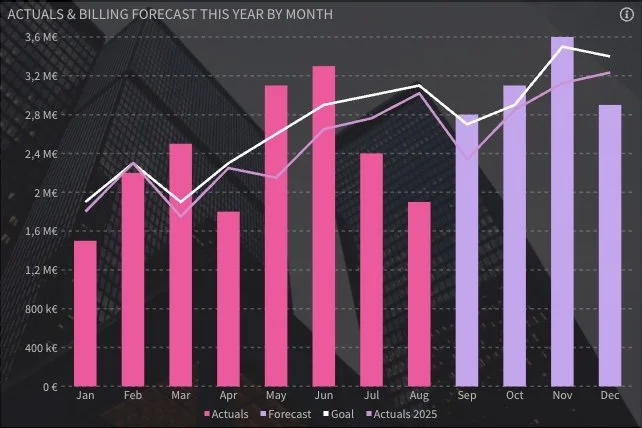
Comparing actual revenue, forecasts and targets in one view helps leadership identify performance trends early and take action before small issues become bigger business problems.
Great Companies Don't Manage One Target
Many organisations begin with a single annual revenue target.
While this provides strategic direction, it rarely helps managers make better day-to-day decisions.
High-performing organisations break strategic objectives into targets that can actually be managed.
Instead of one company-wide number, leadership creates targets at multiple levels of the organisation.
Everyone understands not only the company's goals, but also how their own performance contributes to achieving them.
Start with Company Targets
Everything begins at company level.
These are the numbers discussed in board meetings and annual planning sessions.
Typical company targets include:
Revenue
Billing
Gross Margin
EBITDA
Revenue Growth
Forecast Accuracy
Utilisation
New Business
Customer Retention
These aren't operational KPIs.
They're leadership KPIs.
These targets define success for the organisation as a whole.
Every other target should ultimately support them.
Break Targets Down by Business Unit
As organisations grow, company-level reporting becomes too high-level to manage effectively.
Consider a consulting company with four business units.
Overall revenue may appear healthy.
Yet one business unit could be significantly behind target while another is exceeding expectations.
Without business unit targets, these differences remain hidden until they begin affecting overall company performance.
By setting targets for each business unit, leadership can answer questions such as:
Which teams are driving growth?
Which areas need additional support?
Where should we invest?
Which managers consistently outperform expectations?
Performance becomes visible.
Department and Team Targets
Different teams influence business performance in different ways.
Sales teams cannot directly control utilisation.
Delivery teams cannot directly influence pipeline creation.
Finance teams cannot directly improve win rate.
Each function therefore needs targets that reflect its own responsibilities while supporting the company's overall objectives.
For example, a sales team might focus on:
Revenue target
Pipeline coverage
Win rate
Forecast accuracy
A delivery team might instead monitor:
Billable utilisation
Project profitability
Billing
Customer satisfaction
Different targets. Shared business objectives.
Individual Performance Should Connect to Company Performance
One of the biggest advantages of structured target management is alignment.
Every employee understands how their work contributes to business success.
Salespeople understand their contribution to company revenue.
Business Unit Managers understand how profitability, utilisation and growth affect overall business performance.
Leadership discussions become far more objective because expectations are clear.
Instead of debating opinions, managers review progress against agreed targets.
Coaching becomes much more effective.
The discussion changes from:
"I don't think we're where we should be."
to
"Let's look at the data together. Which targets are on track? Which ones need attention? What support do you need?"
Objective data creates better coaching conversations.
Different Time Horizons Support Better Decisions
Annual targets provide direction.
They rarely create urgency.
Waiting until the end of the financial year to discover performance issues leaves very little opportunity to respond.
Successful organisations therefore manage performance across several time horizons.
Annual targets provide strategic direction.
Quarterly targets help leadership review business performance.
Monthly targets support operational execution.
Weekly reviews help identify issues early enough to take action.
This creates a continuous performance management process rather than a monthly reporting exercise.
Measure Target Attainment
Setting targets is only the beginning.
Leadership also needs to understand how consistently those targets are being achieved.
Target attainment helps leaders identify which business units, teams and individuals are ahead of plan, on track or falling behind.
Every KPI Needs Context
The best dashboards don't simply display numbers.
They provide context.
Revenue means little without a target.
Forecast means little without historical accuracy.
Utilisation means little without profitability.
Leadership should always understand:
Where are we today?
Where did we expect to be?
Where are we likely to finish?
Only then can good decisions be made.
Business Performance Management Is Built Around Conversations
Targets aren't created for dashboards.
They're created for people.
Their purpose is to improve the quality of leadership conversations.
Board meetings become discussions about strategy instead of spreadsheets.
Leadership meetings focus on priorities instead of collecting numbers.
Business reviews identify opportunities instead of explaining surprises.
One-to-one meetings become coaching conversations supported by objective data.
Better decisions start with a shared understanding of performance.
Bringing Business Performance Management to Visma Severa
Visma Severa already provides the operational data needed to run a professional services business.
Sales, projects, resources, time tracking and invoicing already provide the operational data leadership needs.
As organisations grow, many choose to build a Business Performance Management layer on top of that operational foundation.
This makes it easier for leadership to:
define company, business unit, team and individual targets
compare actual performance against targets
align Sales, Finance and Operations around the same trusted numbers
monitor forecast accuracy over time
support recurring leadership meetings with consistent reporting
Rather than replacing Visma Severa, this approach extends the value of the operational data that's already there.
It transforms reporting from a monthly administrative task into an ongoing management process.
A common misconception
Many organisations believe they have a reporting problem.
In reality, they have a Business Performance Management problem.
Reporting tells you what happened.
Targets tell you where you're trying to go.
Business Performance Management brings the two together.
Business Performance Management Is a Leadership Discipline
Technology makes Business Performance Management easier.
It doesn't create it.
The most successful professional services firms establish clear targets, review performance consistently, discuss the right KPIs and use every leadership meeting to make better decisions.
Software should support that process—not define it.
Leadership Meetings: Where Business Performance Management Creates Value
Business Performance Management doesn't happen in dashboards.
It happens in leadership conversations.
Dashboards provide information. Leadership creates action.
Leadership meetings are where decisions are made.
As organisations grow, leadership teams often spend too much time discussing numbers and too little time discussing actions.
Different departments arrive with different reports.
Finance has one version.
Sales has another.
Business unit leaders have their own spreadsheets.
The first thirty minutes disappear into explaining where the numbers came from.
By the time everyone agrees on the figures, there's little time left to discuss what actually matters.
High-performing leadership teams work differently.
They start every meeting from the same trusted view of business performance.
The conversation immediately shifts from reporting to decision-making.
We explore how leading professional services companies structure weekly, monthly and quarterly leadership meetings in our guide How High-Performing Professional Services Companies Run Leadership Meetings.
Every Leadership Meeting Has a Different Purpose
Not every meeting needs the same dashboard.
Nor should every meeting focus on the same KPIs.
Different leadership forums exist to answer different questions.
Understanding that distinction dramatically improves the quality of decision-making.

Business Performance Management brings Sales, Finance and Operations together around the same trusted performance data.
Board Meetings
Board meetings should focus on strategic performance rather than operational detail.
The board wants confidence that the business is progressing according to plan.
Typical discussion topics include:
Revenue performance
Progress against annual targets
Forecast for the coming quarters
Profitability
Business unit performance
Strategic risks and opportunities
Board members rarely need to know which consultant has the highest utilisation this month.
They need to understand whether the business is healthy and where leadership should focus its attention.
A concise executive view almost always leads to better board discussions than dozens of detailed reports.
Leadership Meetings
Weekly or fortnightly leadership meetings connect strategy with execution.
This is where Sales, Finance, Operations and Business Unit leaders align around the same priorities.
Typical questions include:
Are we still on track to reach this quarter's targets?
Has the forecast changed?
Which business units require attention?
Are sales and billing developing as expected?
What decisions do we need to make this week?
These meetings should focus less on reviewing historical performance and more on identifying actions that improve future performance.
Business Reviews
Monthly business reviews allow each business unit or service area to evaluate its own performance.
Rather than looking only at company totals, managers review the performance they can directly influence.
Typical discussion topics include:
Revenue
Billing
Profitability
Utilisation
Pipeline
Forecast
Progress against targets
Using the same KPIs across every business unit creates consistency while still allowing each team to focus on its own priorities.
It also makes comparing performance across the organisation much easier.
Sales Meetings
Sales meetings should always look forward.
Historical revenue is important, but it cannot be changed.
Pipeline, forecasts and target attainment can.
Useful discussion topics include:
Pipeline development
Revenue forecast
Forecast accuracy
Win rate
Sales activity
Progress against revenue targets
The objective isn't to review opportunities.
It's to improve the predictability of future revenue.
One-to-One Coaching
Business Performance Management doesn't stop with executives.
Managers need objective information to coach individuals effectively.
One-to-one meetings become far more valuable when they're based on agreed targets rather than personal opinions.
Useful topics include:
Progress against individual targets
Sales activity
Pipeline quality
Forecast quality
KPI trends
Development priorities
When both manager and employee work from the same information, conversations become more constructive and coaching becomes more objective, more consistent and ultimately more effective.
One Version of the Truth
The greatest benefit of Business Performance Management isn't better dashboards.
It's alignment.
Sales, Finance and Operations all work from the same trusted numbers.
Leadership no longer spends meetings debating which spreadsheet is correct.
Instead, discussions focus on questions such as:
Why has forecast accuracy improved?
Which business unit needs additional support?
How do we improve profitability next quarter?
What actions should we take before the next leadership meeting?
Those are the conversations that move the business forward.
From Reporting to Leadership Cadence
Many organisations treat reporting as a monthly activity.
High-performing organisations treat reporting as part of their leadership cadence.
Every meeting builds on the previous one.
Weekly leadership meetings identify emerging issues.
Monthly business reviews evaluate trends.
Quarterly board meetings focus on strategic direction.
Annual planning uses everything learned throughout the year to set the next generation of targets.
Business Performance Management isn't a report.
It's a continuous management process.
Extending Visma Severa with Business Performance Management
Visma Severa provides the operational data that leadership depends on.
As reporting requirements become more sophisticated, many organisations choose to extend that operational foundation with dedicated Business Performance Management capabilities.
This makes it possible to:
align Sales, Finance and Operations around shared KPIs
compare actual performance against targets
review company, business unit and team performance
support recurring leadership meetings
spend less time preparing reports
The goal isn't to produce more dashboards.
The goal is to improve the quality of every leadership conversation.
Great leadership meetings don't start with spreadsheets.
They start with shared understanding.
When everyone trusts the numbers, leadership can focus on what matters most: making better decisions.
The Leadership Cadence
Weekly → Leadership Meeting
Monthly → Business Review
Quarterly → Board Meeting
Annually → Strategic Planning
Each meeting serves a different purpose, but they should all be built on the same trusted business data.
Choosing the Right Reporting Approach as Your Business Grows
Every professional services company evolves its reporting.
Very few organisations jump directly from operational reports to a sophisticated Business Performance Management process.
Instead, reporting typically matures alongside the business itself.
Understanding where your organisation is today makes it much easier to decide what should come next.
Stage 1: Operational Reporting
In the early years, native reporting is often enough.
Operational reports answer questions such as:
Which projects are running?
How many hours have been booked?
What has been invoiced?
How are consultants utilised?
Which opportunities are currently open?
For small organisations, these reports provide excellent visibility.
Leadership is still close enough to day-to-day operations that relatively little interpretation is required.
This is exactly what systems like Visma Severa are designed to support.
Stage 2: Spreadsheet Reporting
As organisations grow, leadership inevitably begins asking broader business questions.
Finance exports numbers into Excel.
Sales maintains forecasting spreadsheets.
Business units create their own reports.
Board presentations are assembled manually every month.
This stage often develops naturally.
Spreadsheets are flexible.
Everyone knows how to use them.
They solve problems quickly.
Eventually, however, the reporting process itself becomes the problem.
Different teams maintain different versions of the same information.
Leadership meetings begin by discussing whose spreadsheet is correct.
Creating board reports becomes a monthly project rather than a routine task.
Many organisations spend more time preparing reports than using them.
Stage 3: Business Intelligence
As reporting requirements become more sophisticated, many organisations invest in Business Intelligence platforms.
These tools are extremely powerful.
They allow companies to combine multiple operational systems, create highly customised reports and build advanced visualisations.
For organisations with dedicated BI resources, they can become an important part of the reporting landscape.
Business Intelligence platforms are often the right choice when:
multiple systems need to be analysed together
highly customised reporting is required
internal BI expertise already exists
reporting requirements change frequently
The trade-off is flexibility versus simplicity.
The more customised reporting becomes, the more ongoing development and maintenance it typically requires.
Stage 4: Business Performance Management
Eventually, many leadership teams discover that reporting is no longer their biggest challenge.
The challenge becomes improving business performance.
Questions become increasingly forward-looking.
Instead of asking:
"What happened?"
Leadership begins asking:
Are we likely to reach our annual targets?
Which business units are drifting away from plan?
How accurate are our forecasts becoming?
Where should we focus management attention?
Which actions will improve next quarter's results?
Answering those questions requires more than reporting.
It requires a management process built around trusted data, clearly defined targets and recurring leadership reviews.
That is Business Performance Management.
These Approaches Work Together
One common misconception is that organisations must choose a single reporting approach.
In reality, the most successful professional services companies combine several approaches.
Visma Severa manages day-to-day operations.
Spreadsheets remain useful for ad hoc analysis.
Business Intelligence platforms support highly customised reporting.
Business Performance Management brings everything together to help leadership run the business.
Each serves a different purpose.
The goal isn't to replace one tool with another.
The goal is to ensure leadership always has the information needed to make confident decisions.
Has Your Organisation Outgrown Traditional Reporting?
If you're unsure whether your reporting has kept pace with your business, ask yourself these questions.
Can leadership immediately see whether the business is on track to achieve its annual targets?
Do Sales, Finance and Operations work from the same numbers?
Can each business unit measure performance against its own targets?
Are forecasts reviewed regularly and measured for accuracy?
Do leadership meetings focus on decisions rather than collecting numbers?
Can managers quickly identify where leadership attention is needed most?
If you answered "no" to several of these questions, your organisation may have outgrown traditional reporting.
The next step isn't necessarily more dashboards.
It's a better Business Performance Management process.
Extending Visma Severa with Business Performance Management
Visma Severa already provides a strong operational foundation for professional services businesses.
It manages sales, projects, resources, time tracking and invoicing exceptionally well.
As organisations grow, many choose to extend that foundation with Business Performance Management.
This helps leadership:
Align Sales, Finance and Operations around the same trusted KPIs.
Monitor performance at company, business unit and team level.
Compare actual performance against targets, budgets and forecasts.
Improve forecasting and forecast accuracy.
Support board meetings, leadership meetings and business reviews with consistent reporting.
Rather than replacing Visma Severa, this approach helps organisations get more value from the operational data they already trust.
Running a Better Professional Services Business
Professional services businesses don't succeed because they collect more data.
They succeed because they make better decisions.
As organisations grow, the challenge shifts from running projects to running the business.
Leadership needs confidence that the organisation is moving in the right direction.
That confidence comes from answering three simple questions:
Where are we today?
Where are we trying to go?
What should we do next?
Business Performance Management connects operational data, targets, forecasts and leadership reporting into one consistent management process.
The result isn't better dashboards.
It's better decisions.
Start Small. Improve Continuously.
Building a mature Business Performance Management process doesn't happen overnight.
It develops gradually.
Leadership asks better questions.
Targets become clearer.
Forecasts become more reliable.
Leadership meetings become more focused.
Decisions become faster.
Small improvements, repeated consistently, create significant long-term advantages.
How Dear Lucy Extends Visma Severa
Dear Lucy builds on Visma Severa by giving leadership teams a dedicated Business Performance Management layer.
With Dear Lucy you can:
Set and monitor company, business unit, team and individual targets.
Compare actual performance against targets, budgets and forecasts.
Review performance through board meetings, leadership meetings and business reviews.
Combine sales, finance and operational KPIs into one executive view.
Reduce manual reporting while improving decision-making.
The goal isn't to replace Visma Severa.
It's to help leadership get more value from the operational data that's already there.
See Business Performance Management in Action
If you're using Visma Severa and your leadership team spends more time preparing reports than discussing decisions, it may be time to move beyond traditional reporting.
See how growing professional services companies extend Visma Severa with Business Performance Management.
→ Explore Dear Lucy for Visma Severa
Continue Reading
Why Every KPI Needs a Target
Learn why targets transform KPIs from historical reports into management tools, and how leading professional services companies use target management to improve leadership decisions.
Frequently Asked Questions
What is Business Performance Management?
Business Performance Management is the process of measuring performance against targets, monitoring trends, improving forecasts and helping leadership make better business decisions.
Unlike traditional reporting, it focuses not only on what happened, but also on what is likely to happen next and what actions leadership should take.
What's the difference between reporting and Business Performance Management?
Reporting explains what happened.
Business Performance Management helps leadership understand whether the business is on track, why performance is changing and what actions to take next.
In simple terms:
Reporting provides information.
Business Performance Management supports decisions.
Which KPIs should a professional services company track?
Every organisation is different, but most leadership teams regularly monitor:
Revenue
Billing
Forecast
Forecast Accuracy
Pipeline Coverage
Win Rate
Utilisation
Project Profitability
Business Unit Performance
Progress Against Targets
The most valuable KPIs are those directly linked to the company's strategic objectives and reviewed consistently over time.
How often should leadership review business performance?
High-performing organisations establish a regular leadership cadence rather than relying on monthly reporting alone.
A typical cadence includes:
Weekly leadership meetings
Monthly business reviews
Quarterly board meetings
Annual strategic planning
Each meeting should have a different purpose while using the same trusted business data.
Can Visma Severa be used for executive reporting?
Visma Severa provides an excellent operational foundation for professional services businesses.
As organisations grow, many choose to extend Severa with dedicated Business Performance Management capabilities to support executive reporting, target management, forecasting and leadership reviews.
When do companies typically outgrow spreadsheets?
Spreadsheets work well for many growing businesses.
The tipping point usually comes when leadership spends more time preparing reports than discussing decisions.
If different departments maintain separate spreadsheets and leadership meetings begin by reconciling numbers, it's often time to adopt a more structured reporting and performance management approach.
Do we need Business Intelligence software as well?
Not necessarily.
Operational reporting, spreadsheets, Business Intelligence platforms and Business Performance Management each solve different problems.
Many organisations use them together.
The right combination depends on your reporting requirements, internal expertise and the complexity of your business.
Can Business Performance Management replace Business Intelligence?
No. They serve different purposes.
Business Intelligence platforms are designed to analyse and visualise data from multiple sources.
Business Performance Management focuses on helping leadership set targets, monitor performance, improve forecasting and make better business decisions.
Many organisations use both together.
Why I added this: It's a natural question after discussing Business Intelligence in the article, and it's exactly the kind of follow-up people ask AI assistants.
Can Business Performance Management be built on top of Visma Severa?
Yes.
Many professional services companies continue using Visma Severa as their operational system while extending it with Business Performance Management capabilities such as target management, executive reporting, forecasting and leadership dashboards.
This approach allows organisations to build on the operational data already stored in Severa rather than replacing it.
Final Thoughts
If you've read this far, you've probably noticed one recurring theme.
Business Performance Management isn't about building more dashboards.
It's about helping leadership teams make better decisions.
Visma Severa already provides the operational foundation for running a professional services business.
Business Performance Management builds on that foundation by bringing together operational data, targets, forecasts and executive reporting into one consistent management process.
Because ultimately, the goal isn't better reports.
It's a better-run business.